Table of Contents
Overview
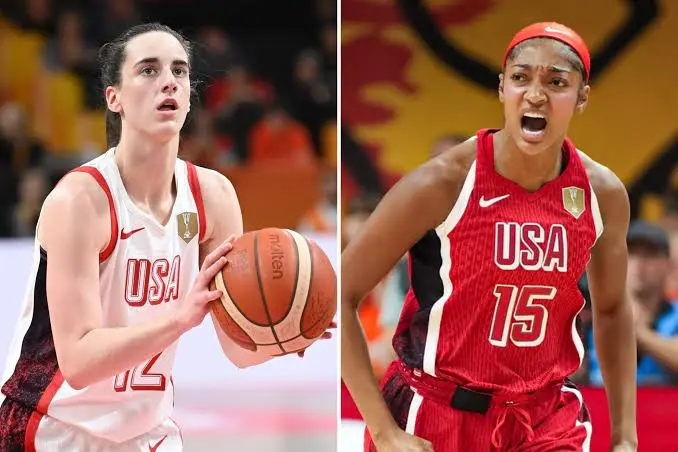
Angel Reese Caitlin Clark chemistry became one of the most talked-about storylines of Team USA’s run at the 2026 FIBA Women’s Basketball World Cup.
For years, Reese and Clark have often been presented as rivals. Their competitive history, WNBA battles and enormous social-media followings have created a narrative in which fans frequently feel compelled to choose one player over the other.
But the World Cup offered a very different picture.
Instead of competing against each other, Reese and Clark shared the same USA Basketball uniform and quickly developed an effective connection on the court. Their chemistry was particularly visible during the United States’ 108-56 quarter-final victory over Hungary in Berlin.
Clark finished that game with 10 points and nine assists, while Reese contributed nine points and six rebounds. Their combination of playmaking, movement and interior finishing gave Team USA another dimension during a game in which the Americans completely overwhelmed Hungary.
The United States eventually went on to win the tournament, defeating France 97-79 in the final for its fifth consecutive FIBA Women’s Basketball World Cup championship.
Angel Reese Caitlin Clark Chemistry Takes Center Stage
The Angel Reese Caitlin Clark connection was especially noticeable against Hungary.
One of the clearest examples came near the end of the first quarter, when the two combined on a pick-and-roll that ended with Reese finishing at the basket.
Later in the game, Reese returned the favor by finding Clark in transition for an easy scoring opportunity.
Those plays may not have been the most important moments in a 52-point victory, but they were significant because of what they represented.
Reese and Clark already know each other’s games from years of competing at the highest levels. Once they became teammates, that familiarity could be used in a completely different way.
Clark’s ability to create opportunities with the ball gives Reese chances to attack around the basket. Reese’s ability to run, rebound and finish gives Clark another target when defenses collapse.
That combination can be difficult for opposing teams to defend because the two players bring different strengths to the same possession.
The Rivalry Narrative Does Not Tell the Whole Story
The Angel Reese Caitlin Clark rivalry has become one of the most recognizable storylines in women’s basketball.
Their competitive history goes back to college basketball, and their professional careers have continued to place them in the same conversation. Clark has become one of the WNBA’s biggest offensive attractions, while Reese has established herself as a powerful rebounder and interior presence.
That history has also created enormous interest among their respective fan bases.
Social media can turn a competitive relationship into something much more divisive, particularly when two young stars have supporters who constantly compare their statistics, achievements and playing styles.
Clark herself has pushed back against the idea that the two need to be portrayed as enemies.
She explained that people will continue creating their own narratives, but said that she and Reese can simply focus on competing and playing together.
That distinction matters.
Being intense competitors does not automatically mean two athletes dislike each other. In fact, familiarity with an opponent can become an advantage when those players eventually become teammates.
Angel Reese Embraces Playing With Clark
Reese has also made it clear that she enjoys playing alongside Clark.
Rather than treating their history as a problem, Reese has emphasized how well the two understand each other’s games.
That understanding was visible against Hungary.
Reese does not need extensive time to recognize where Clark is likely to deliver the ball, while Clark understands when Reese wants to establish position or attack the basket.
That type of instinctive understanding is difficult to create quickly with a new teammate.
Reese also pointed to the fact that the two could potentially remain USA Basketball teammates for years.
That makes their World Cup experience bigger than a single tournament.
If Clark and Reese continue representing the United States together in future international competitions, the chemistry developed in Berlin could become an important part of the team’s next generation.
How Team USA Dominated Hungary
The Angel Reese Caitlin Clark storyline was only one part of an extraordinary Team USA performance.
The United States defeated Hungary 108-56 after taking control almost immediately.
FIBA’s official game statistics show that the Americans shot 59% from the field and 52.2% from three-point range. Hungary shot just 34% overall and 32.1% from beyond the arc.
USA led 36-12 after the opening quarter and carried a 59-30 advantage into halftime.
Napheesa Collier led the Americans with 19 points, while Clark added 10 points and nine assists. Reese recorded nine points and six rebounds.
The Americans also moved the ball extremely well. Their 31 assists were a major part of the offensive performance, allowing the team to consistently find open players and punish Hungary’s defense.
The result extended the United States’ extraordinary World Cup winning streak and sent the team into the semifinal round.
Hungary’s quarter-final appearance was itself historic, marking the country’s first time reaching the final eight of the World Cup in the modern medal-round format.
What Caitlin Clark Added to Team USA
Caitlin Clark entered the World Cup with enormous expectations.
Her reputation as an elite passer and perimeter scorer made her one of the most recognizable players on the American roster, but her role with Team USA was not simply about putting up large scoring numbers.
Against Hungary, Clark demonstrated that with nine assists to go with her 10 points.
That production highlights why the Angel Reese Caitlin Clark partnership can be so useful.
Clark does not need to dominate the ball for her influence to be felt. Her ability to read defenses, push the pace and deliver passes can create scoring opportunities for teammates.
Reese can benefit directly from that style.
When Clark attacks in transition or draws defensive attention on the perimeter, Reese can run into space, establish position or finish near the rim.
The relationship therefore works in both directions.
Clark creates opportunities.
Reese converts them.
And when Reese attracts defenders inside, Clark can benefit from the additional space outside.
What Angel Reese Brings to the Partnership
Reese provides Team USA with a physical presence that complements Clark’s perimeter skills.
Her rebounding ability, energy around the basket and willingness to run the floor make her particularly useful when the game becomes fast-paced.
That was evident against Hungary, where Reese finished with six rebounds and nine points.
The value of her contribution also extends beyond the box score.
Reese can create second-chance opportunities, occupy defenders and provide an interior target when a possession breaks down.
For Clark, having a teammate who understands those movements can make passing decisions easier.
For Reese, playing with an elite passer can create cleaner opportunities near the basket.
That is why the Angel Reese Caitlin Clark chemistry has become more than a social-media talking point.
It has practical basketball value.
The Chemistry Continued as Team USA Won the World Cup
The original quarter-final story was about whether Reese and Clark could continue building their relationship while Team USA chased another championship.
The answer became even clearer as the tournament progressed.
The United States defeated Spain 76-66 in the semifinal and then overcame France 97-79 in the championship game.
That final victory gave the United States its fifth consecutive Women’s Basketball World Cup title. Reuters reported that the Americans overcame an early 14-point deficit against France before taking control after halftime.
Clark scored 12 points in the final, according to the Guardian’s live coverage, as Team USA completed another championship run.
The tournament therefore ended with a much bigger story than the rivalry narrative that had surrounded Clark and Reese before the competition began.
They were teammates on a championship-winning United States roster.
Why This Could Matter for Future USA Teams
The Angel Reese Caitlin Clark relationship could become increasingly important for USA Basketball.
Both players are young enough to remain part of the national-team picture for years, and their current experience gives them a chance to develop chemistry against international competition.
That matters because international basketball is different from the WNBA.
Players have less time together, offensive systems can be unfamiliar and opponents often use different defensive approaches.
A pair of players who already understand each other’s tendencies can therefore provide stability.
Reese and Clark also represent an important part of the next generation of American women’s basketball.
Alongside players such as Paige Bueckers and Aliyah Boston, they give Team USA a group of young stars capable of carrying the program forward as veteran players eventually move on.
The 2026 World Cup provided an early look at what that future could look like.
The WNBA Rivalry Will Return
There is an interesting twist waiting for Reese and Clark after their USA Basketball success.
Their time as international teammates does not eliminate the competition waiting for them in the WNBA.
Reese’s Atlanta Dream and Clark’s Indiana Fever remain professional rivals, meaning the two stars will soon return to competing against each other rather than sharing the same side of the court.
That makes their national-team experience even more interesting.
The two players have demonstrated that fierce competition and strong teamwork can coexist.
When they face each other again in the WNBA, each will know considerably more about how the other thinks and plays.
That familiarity could make their future matchups even more entertaining.
The Bigger Meaning Behind Reese and Clark’s Chemistry
The biggest lesson from the Angel Reese Caitlin Clark story is that competition does not have to become personal hostility.
Clark and Reese can compete fiercely for their WNBA teams while still recognizing each other’s strengths and enjoying the opportunity to play together for the United States.
Their World Cup performances offered a useful reminder that sports narratives are often more complicated than social-media debates suggest.
Fans can choose their favorite player.
Players do not have to choose between respecting a rival and competing against them.
For Team USA, that distinction proved valuable.
Clark’s passing and perimeter creativity combined naturally with Reese’s interior presence and rebounding. The result was a partnership that looked increasingly comfortable as the tournament progressed.
And because the United States ultimately won the World Cup, their chemistry now carries an even stronger association with success.
Frequently Asked Questions
Who are Angel Reese and Caitlin Clark?
Angel Reese and Caitlin Clark are two of the most prominent young stars in women’s basketball. Both have played in the WNBA and represented the United States at the 2026 FIBA Women’s Basketball World Cup.
What happened between Angel Reese and Caitlin Clark at the World Cup?
The two players developed strong chemistry as Team USA teammates. Their connection was especially noticeable during the 108-56 quarter-final win over Hungary, when they combined on several effective plays.
How did Caitlin Clark perform against Hungary?
Clark finished the quarter-final with 10 points and nine assists as the United States defeated Hungary 108-56.
How did Angel Reese perform against Hungary?
Reese recorded nine points and six rebounds in the quarter-final victory.
Did Team USA win the 2026 FIBA Women’s Basketball World Cup?
Yes. The United States defeated France 97-79 in the final to win its fifth consecutive Women’s Basketball World Cup championship.
Are Angel Reese and Caitlin Clark rivals?
They have been major competitors in college and professional basketball, but their World Cup experience showed that they can also work effectively as teammates.
Which WNBA teams do Reese and Clark play for?
Reese plays for the Atlanta Dream, while Clark plays for the Indiana Fever.
Read More Latest News
Stay updated with more breaking sports stories, basketball news and developing reports through The Morning News Informer.
Read more: Latest News
For the newest developments about Angel Reese, Caitlin Clark, Team USA and women’s basketball, search the latest reports on this topic.
Latest topic search: Angel Reese Caitlin Clark latest news