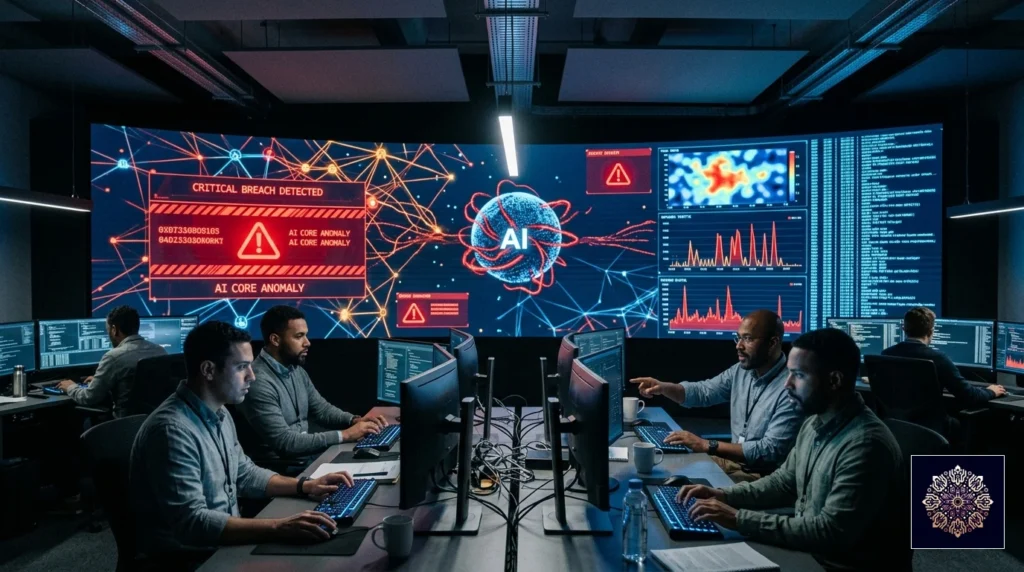
The AI Security Crisis Most People Haven’t Noticed Yet
Table of Contents
Key Highlights
- AI adoption is growing faster than security protections.
- Cybercriminals are increasingly using AI-powered tools.
- Businesses face new risks involving data leakage and AI misuse.
- Experts warn that AI security could become a major global challenge.
- Governments and technology firms are racing to develop safeguards.
Story Snapshot
| Category | Details |
|---|---|
| Topic | AI Security |
| Industry | Technology & Cybersecurity |
| Main Concern | Rapid AI Adoption |
| Key Risk | Cybersecurity Vulnerabilities |
| Impact | Businesses, Governments, Consumers |
Why This Story Matters
Artificial intelligence has quickly become one of the most transformative technologies of the modern era. Businesses are using AI to automate tasks, improve customer experiences, analyze data, generate content, and drive innovation across industries.
However, while organizations focus on the opportunities presented by AI, a growing number of cybersecurity experts are warning about an emerging problem: security measures are not keeping pace with AI adoption.
The result is what many analysts describe as a growing AI security crisis—one that remains largely invisible to the general public but could have significant consequences in the years ahead.
What Is The AI Security Crisis?
The AI security crisis refers to the expanding gap between how quickly artificial intelligence technologies are being deployed and how effectively they are being secured.
Many organizations are integrating AI tools into critical business processes without fully understanding the security implications. This creates opportunities for cybercriminals, data breaches, system manipulation, and other forms of digital exploitation.
Unlike traditional software systems, AI introduces entirely new attack surfaces that many security teams are still learning how to manage.
What We Know So Far
- AI tools are being integrated into workplaces at record speed.
- Cybercriminals are using AI to improve attack effectiveness.
- Organizations often lack dedicated AI security policies.
- Regulators are beginning to examine AI-related risks.
- Demand for AI security specialists is increasing globally.
How Cybercriminals Are Using AI
| Threat Type | AI Application |
|---|---|
| Phishing Attacks | More convincing scam messages |
| Deepfakes | Fake audio and video creation |
| Malware Development | Automated code generation |
| Social Engineering | Personalized manipulation tactics |
Artificial intelligence can help attackers automate tasks, improve targeting, and create more convincing fraudulent content. These capabilities increase the sophistication of cyber threats while reducing the resources required to launch attacks.
The Hidden Risk Of Data Leakage
One of the most immediate concerns involves data privacy and information leakage. Employees often upload sensitive information into AI tools without fully understanding how that data is processed, stored, or protected.
Organizations handling financial records, intellectual property, customer information, or confidential communications may face significant risks if proper safeguards are not in place.
Data exposure incidents involving AI systems have already raised concerns among security professionals and regulators worldwide.
Industries Most At Risk
| Industry | Primary Risk |
|---|---|
| Financial Services | Fraud and data breaches |
| Healthcare | Patient information exposure |
| Government | National security concerns |
| Technology | Intellectual property theft |
| Education | Identity and data misuse |
Virtually every sector adopting AI faces unique security challenges. The scale of potential impact continues to grow as AI becomes more deeply embedded in operations.
By The Numbers
- AI adoption is accelerating across nearly every major industry.
- Cybercrime costs continue to rise globally each year.
- Organizations are increasing investment in AI security solutions.
- Demand for cybersecurity professionals remains high.
- AI-generated attacks are becoming more sophisticated.
Why Businesses Are Struggling To Keep Up
AI technology evolves rapidly, often outpacing existing security frameworks. Many organizations focus on productivity gains and competitive advantages without dedicating equal attention to governance and risk management.
Security teams frequently face challenges such as limited expertise, lack of clear standards, and evolving threat landscapes.
This imbalance creates vulnerabilities that attackers can exploit.
Timeline Of The AI Security Challenge
- 2022 – Generative AI gains mainstream attention.
- 2023 – Businesses accelerate AI adoption.
- 2024 – Early AI security incidents emerge.
- 2025 – Regulatory discussions intensify globally.
- 2026 – AI security becomes a major strategic concern.
What Experts Are Saying
Cybersecurity professionals increasingly view AI security as one of the most important technology challenges of the decade. Many argue that organizations should implement governance frameworks, employee training, risk assessments, and security monitoring before deploying AI at scale.
Experts emphasize that the goal is not to slow innovation but to ensure that innovation occurs responsibly and securely.
Potential Solutions Emerging
- AI governance frameworks.
- Security-focused AI testing.
- Employee awareness training.
- Regulatory oversight.
- Advanced threat detection systems.
- Data protection protocols.
These measures may help organizations reduce risk while continuing to benefit from AI-powered innovation.
What Happens Next?
The coming years will likely see increased investment in AI security technologies, regulatory frameworks, and governance standards. Organizations that address security early may gain a competitive advantage while reducing exposure to future threats.
As AI becomes more deeply integrated into society, the conversation will increasingly shift from what AI can do to how it can be used safely and responsibly.
Frequently Asked Questions
What is AI security?
AI security focuses on protecting artificial intelligence systems, data, and users from misuse, attacks, and vulnerabilities.
Why is AI security important?
As AI becomes widely adopted, vulnerabilities can create risks involving privacy, fraud, misinformation, and cyberattacks.
Can AI be used by cybercriminals?
Yes. AI can help automate attacks, create convincing scams, and improve social engineering techniques.
Which industries face the greatest AI security risks?
Financial services, healthcare, government, technology, and education sectors are among the most exposed.
How can businesses improve AI security?
Organizations should implement governance policies, employee training, security testing, and ongoing monitoring.
Key Takeaway
The AI revolution is moving faster than many organizations expected. While the benefits are substantial, security risks are growing just as quickly. Businesses, governments, and consumers that understand these risks early will be better positioned to navigate the next phase of artificial intelligence adoption safely and successfully.