Table of Contents
Key Highlights
- NASA’s MAVEN mission is concluding after more than a decade in orbit around Mars.
- The spacecraft helped scientists understand how Mars lost much of its atmosphere.
- MAVEN provided critical data about the Red Planet’s climate evolution.
- The mission contributed to future Mars exploration planning.
- Its discoveries remain among the most important in planetary science.
Story Snapshot
| Mission | MAVEN |
|---|---|
| Agency | NASA |
| Destination | Mars |
| Main Objective | Study Mars’ Atmosphere |
| Legacy | Revolutionized Understanding Of Mars |
A Historic Chapter In Mars Exploration Comes To A Close
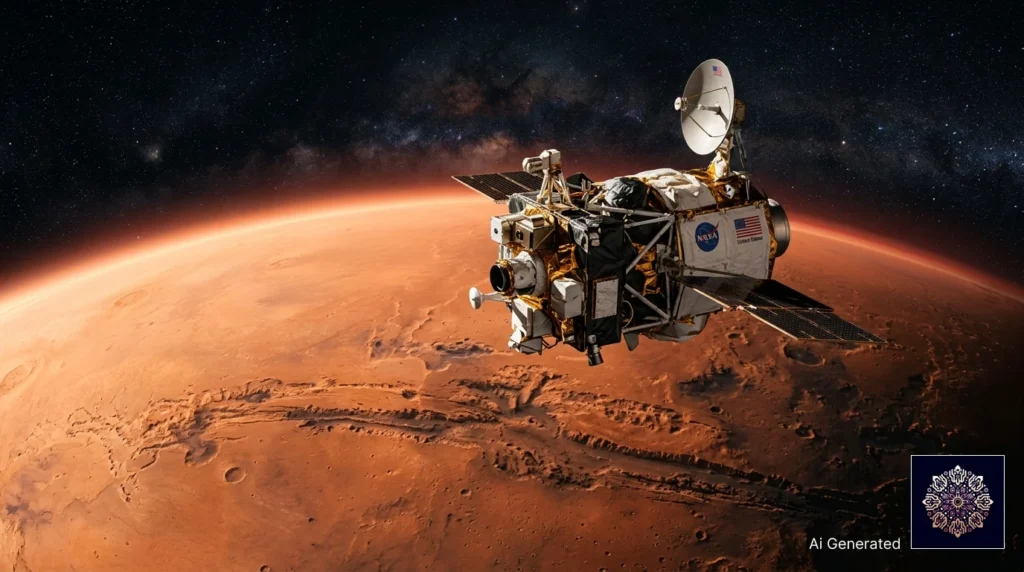
NASA’s MAVEN mission is reaching the end of a remarkable journey that has helped reshape humanity’s understanding of Mars. Since entering orbit around the Red Planet, the spacecraft has spent years gathering data about the Martian atmosphere and investigating one of the most important mysteries in planetary science.
Scientists have long wondered how Mars transformed from a planet that may once have supported liquid water into the cold, dry world visible today. MAVEN played a crucial role in answering that question.
Although the mission is ending, its scientific legacy will continue influencing research and future exploration efforts for decades.
What Was The MAVEN Mission?
MAVEN stands for Mars Atmosphere and Volatile Evolution. The mission was specifically designed to study the upper atmosphere of Mars and understand how the planet lost much of its atmosphere over time.
By analyzing interactions between the atmosphere and solar activity, scientists hoped to determine how environmental changes shaped the evolution of Mars.
The mission became one of NASA’s most successful scientific efforts focused on planetary climate history.
Why Mars Lost Its Atmosphere
| Question | MAVEN’s Contribution |
|---|---|
| Atmospheric Loss | Measured Escape Processes |
| Solar Wind Impact | Tracked Atmospheric Stripping |
| Climate Evolution | Provided Long-Term Evidence |
| Habitability | Improved Understanding |
One of MAVEN’s most important discoveries involved the role of solar wind. Unlike Earth, Mars lacks a strong global magnetic field that can shield its atmosphere from charged particles emitted by the Sun.
Over billions of years, solar activity gradually stripped away large portions of the Martian atmosphere, contributing to dramatic climate changes.
Major Discoveries Made By MAVEN
- Confirmed significant atmospheric loss over time.
- Measured interactions between solar wind and Mars.
- Improved understanding of planetary climate evolution.
- Collected extensive atmospheric data.
- Supported future exploration planning.
These discoveries helped explain how Mars changed from a potentially wetter world into the environment observed today.
How MAVEN Changed Mars Science
Before MAVEN, scientists had theories about atmospheric loss but lacked detailed measurements needed to test them.
The mission provided unprecedented insights into how planetary environments evolve and how solar activity influences atmospheric stability.
Its findings also have implications beyond Mars, helping researchers study exoplanets and planetary systems elsewhere in the universe.
Why The Mission Matters For Future Human Exploration
Understanding the Martian atmosphere is essential for future robotic and human missions.
Knowledge gathered by MAVEN contributes to mission planning, landing system design, communication strategies and long-term exploration objectives.
As space agencies and private companies continue discussing crewed missions to Mars, data from MAVEN remains highly valuable.
By The Numbers
- More than a decade of scientific operations.
- Millions of observations collected.
- Extensive atmospheric measurements.
- Major contributions to planetary science.
- Support for future Mars exploration programs.
What’s Next For Mars Exploration?
| Future Focus | Goal |
|---|---|
| Sample Return Missions | Bring Mars Material To Earth |
| Human Exploration | Prepare For Crewed Missions |
| Climate Studies | Expand Atmospheric Research |
| Technology Development | Support Long-Term Presence |
MAVEN’s findings will continue supporting future scientific investigations and exploration initiatives.
Timeline Of The MAVEN Mission
- Mission approved by NASA.
- Spacecraft launched toward Mars.
- Entered Martian orbit.
- Collected atmospheric data for more than a decade.
- Mission concludes after historic scientific achievements.
Frequently Asked Questions
What was the MAVEN mission?
MAVEN was a NASA spacecraft designed to study Mars’ atmosphere and climate evolution.
Why is MAVEN important?
The mission helped explain how Mars lost much of its atmosphere and became the planet observed today.
Did MAVEN discover signs of life?
The mission focused on atmospheric science rather than direct searches for life.
How long did MAVEN operate?
The spacecraft spent more than a decade conducting scientific observations around Mars.
What happens next?
Future missions will build upon MAVEN’s discoveries to advance Mars exploration and scientific understanding.
Key Takeaway
NASA’s MAVEN mission represents one of the most important achievements in modern planetary science. By helping scientists understand how Mars lost its atmosphere, the spacecraft provided crucial insights into the history of the Red Planet and the processes that shape planetary environments. While the mission itself may be ending, its discoveries will continue guiding Mars research and future exploration efforts for years to come.