Table of Contents
- Introduction
- The 10 Major Sarkari Naukri Schemes Launched by Nitish Kumar
- Who Benefits & Eligibility
- How to Apply — Practical Steps
- Impact: What These Schemes Have Achieved
- Challenges & What Could Improve
- Conclusion & Next Steps
- Related Reads
Introduction:Top Sarkari Naukri Schemes in Bihar
Over two decades in office, Nitish Kumar’s Bihar government has repeatedly prioritised youth employment, skilling and social safety nets Top Sarkari Naukri Schemes in Bihar. From targeted cash allowances for unemployed youth to large-scale skilling drives and women-focused enterprise schemes, Bihar’s policy mix aims to expand access to stable work and to create pathways from training to formal jobs. This article lists and explains the 10 most significant sarkari naukri (government job and employment) schemes introduced under his administration, what each scheme offers, who is eligible, and how jobseekers can engage with them.
The 10 Major Sarkari Naukri Schemes Launched by Nitish Kumar
1. Mukhyamantri Nischay Swayam Sahayata Bhatta Yojana (MNSSBY) — 2016
The MNSSBY provides a monthly allowance of ₹1,000 for up to two years to unemployed youth aged 20–25 who are actively looking for work or preparing for competitive and skill-based examinations. The scheme was launched to reduce immediate financial pressure on jobseekers so they can focus on employability and training. Official district portals and the state’s youth mission website host the application and verification steps for beneficiaries.

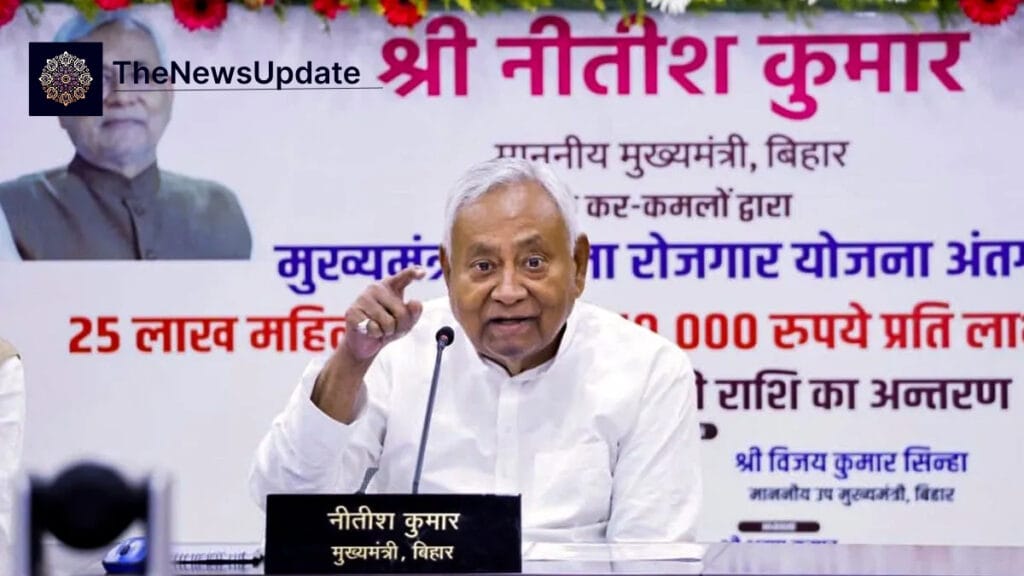
2. Mukhyamantri Mahila Rozgar Yojana — 2025
Introduced as a major women’s livelihood initiative, this scheme offers an initial grant (reported instalments of ₹10,000) followed by access to larger assistance — in many cases staged support up to significant loan/grant packages — to help women launch micro-enterprises such as tailoring, dairy, retail or beauty services. The scheme explicitly targets household-level entrepreneurship and has been rolled out with direct bank transfers to beneficiaries. Recent state announcements highlight periodic instalments and outreach to ensure coverage across panchayats. :contentReference[oaicite:1]{index=1}
3. Bihar Student Credit Card Yojana — 2016 (Expanded)
Designed to reduce financial barriers to higher education, the Bihar Student Credit Card offers students access to education loans up to specified limits (commonly cited up to ₹4 lakh) for technical, professional and job-oriented courses. The scheme has been instrumental in enabling first-generation learners to pursue degrees and vocational training without upfront costs, strengthening the long-term employability of Bihar’s youth. (Check the state education department portal for current loan ceilings and application windows.)
4. Bihar Skill Development Mission & Kushal Yuva Programme (KYP) — 2010 / 2016

The Bihar Skill Development Mission (BSDM) is the state’s primary body for training and placement. Its flagship Kushal Yuva Programme (KYP) provides short-term and long-term training, apprenticeships and digital literacy modules for youth aged typically 15–28 (with relaxed age limits for reserved categories). The KYP operates through centres across districts, links training to Model Career Centres and aims to connect trainees with industry placements.

5. Model Career Centres (since 2014)
Model Career Centres modernise and replace traditional employment exchanges by offering career counselling, resume building, job registration and placement assistance for both government and private roles. These centres conduct job fairs, coordinate with employers and provide a first-stop digital and offline service for jobseekers across Bihar’s districts.
6. Large-Scale Teacher Recruitment Drives (2019–2025)
Bihar has periodically conducted transparent, exam-based teacher recruitment to fill vacancies in primary, upper-primary and secondary schools. These drives have created substantial numbers of stable public-sector jobs and aimed to improve the quality of education by ensuring merit-based selection and compliance with state norms.
7. Mukhyamantri Pratigya Yojana (CM Pratigya) — 2023
CM Pratigya focuses on workplace readiness by offering interns and paid placements in industry for 12th-pass and graduate youth, with stipend support to cover living costs during internships. The scheme is intended to bridge the gap between classroom learning and industry expectations by providing practical exposure and structured pathways to employment. Recent rollouts have featured a digital portal to match interns with employers.

8. Employment Assistance & Welfare for Construction Workers (2023–24)
Recognising the large informal workforce in construction, Bihar’s labour resources initiatives provide registered construction workers with welfare benefits including pension top-ups, insurance coverage, medical assistance and occasional cash transfers. These supports are targeted at stabilising incomes and formalising benefits for daily-wage earners. Recent transfers and mass enrolment drives have been publicised around festivals and labour events.
9. Kaushal Yuva Programme (KYP) — 2016 (BSDM flagship)
KYP is framed as an accessible, large-scale skilling programme that focuses on trades, hospitality, retail, manufacturing and IT-enabled services. With flexible entry requirements (10th pass minimum for many courses) and special age relaxations for reserved categories, KYP offers industry-aligned modules designed to increase short-term employability and apprenticeship access.
10. Bihar Online Job Portal (Revamped 2020) — det.bihar.gov.in & Consolidated Portals
The state’s online job portal consolidates government and private openings, allows youth to register profiles, apply for departmental vacancies and participate virtually in job fairs. Digitisation of job registration has improved transparency and widened access for rural jobseekers who previously relied on local noticeboards or in-person exchanges.

Who Benefits & Eligibility — Quick Overview
- Unemployed youth (20–25): MNSSBY cash allowance while searching for jobs or training.
- Women entrepreneurs: Mukhyamantri Mahila Rozgar Yojana offers seed instalments and follow-on assistance for micro-enterprises.
- Students & first-generation learners: Bihar Student Credit Card enables access to higher and professional education.
- Skilled trainees: KYP and BSDM trainees gain certified skill modules and placement assistance.
- Informal construction workers: Welfare benefits, pensions and periodic cash transfers under labour department schemes.
How to Apply — Practical Steps for Jobseekers
- Check official portals first: Use the respective scheme websites (BSDM/KYP, 7Nishchay youth mission portal, the Mukhyamantri Mahila Rozgar portal and the state employment portal) to confirm eligibility, download forms and track instalments. :contentReference[oaicite:10]{index=10}
- Prepare documents: Aadhaar, caste/beneficiary certificates (if applicable), educational certificates, bank account details and a local address proof are typically required for registration and verification.
- Visit Model Career Centres: For counselling, résumé help and to register for local job fairs and placement drives.
- For women entrepreneurs: enrol in the Mahila Rozgar portal, complete basic entrepreneurship training, and track instalment schedules online.
- For students: apply for the Bihar Student Credit Card and consult college/course partners for loan processing timelines.
Impact: What These Schemes Have Achieved So Far
These initiatives together create a layered approach to employment — immediate cash support to reduce job-search stress, large-scale skilling to build capabilities, digitised job-matching to improve transparency, and sectoral pushes (education hires, construction worker relief, women’s enterprise grants) to broaden who benefits. Publicised transfers and recruitment drives show the government’s intent to reach millions of beneficiaries through direct transfer mechanisms and online portals. Recent government communications and local news reports highlight multi-crore transfers and large internship targets as evidence of scale.
Challenges & What Could Improve
- Recognition to placement gap: Training-to-job conversion rates need continued improvement; stronger industry linkages and post-training placement support will matter.
- Geographic access: Rural youth sometimes lack awareness or internet access; mobile outreach and district-level facilitation remains crucial.
- Quality assurance: Ensuring uniform training quality across centres and consistent monitoring of outcomes will increase the impact of the KYP and related programmes.
- Language & soft skills: Employers increasingly demand communication and workplace readiness; integrating these modules into training helps graduates compete.
Conclusion & Next Steps
Nitish Kumar’s government has assembled a pragmatic portfolio of schemes that target immediate income needs, long-term employability and local entrepreneurship. For jobseekers in Bihar, the recommended next steps are straightforward: register on the state job portal, visit Model Career Centres, enrol in KYP or related BSDM courses, and — for women entrepreneurs — apply through the Mukhyamantri Mahila Rozgar portal to access starter grants. Together these pathways can convert government policy into real jobs and sustainable livelihoods across Bihar.
Related Reads
By The News Update — Updated November 23, 2025