By The Morning News Informer | Updated December 15, 2025
Sai Jadhav Indian Military Academy, a 23-year-old officer from Kolhapur, Maharashtra, has scripted a landmark chapter in India’s military history by becoming the first woman officer to pass out from the Indian Military Academy (IMA), Dehradun. Her commissioning ends a 93-year-long chapter in which the academy—established in 1932—had trained over 67,000 officers, all of them men. With her graduation, a historic threshold has finally been crossed.
This moment is not merely symbolic. It reflects years of legal battles, policy reforms, and changing social attitudes toward women in uniform. Sai Jadhav’s achievement is being seen as a turning point that could redefine the future of women’s participation in India’s armed forces.
यह भी पढ़े:
 Osman Hadi Killers Fled to India via Meghalaya Border: Dhaka Police Reveal Shocking Escape Route
A Historic First for the Sai Jadhav Indian Military Academy
The Indian Military Academy in Dehradun is among the most prestigious officer-training institutions in the country. It has produced generations of leaders who have gone on to command troops in wars, counter-insurgency operations, peacekeeping missions, and strategic command roles. For decades, the academy remained an exclusively male bastion.
Sai Jadhav’s commissioning breaks that tradition. She becomes the first woman officer to complete training at the IMA and receive her commission from the institution. The milestone holds immense significance not only for women aspirants but also for the Indian Army, which has been steadily expanding avenues for women officers.
Her presence at the passing-out ceremony—where cadets march proudly in front of the iconic Chetwode Building—marked a moment many described as “long overdue.”
यह भी पढ़े:
 Bulldozer Raj Karnataka Demolitions: Congress Govt Faces Backlash After 400 Muslims Left Homeless
A Family Legacy of Service
Sai Jadhav’s journey into uniform is deeply rooted in family tradition. She is the fourth generation of her family to serve in the armed forces. Her great-grandfather served in the British Indian Army, her grandfather held a commission in independent India’s Army, and her father, Sandeep Jadhav, continues to serve as an officer.
Growing up in a military household meant frequent transfers across states, exposure to diverse cultures, and an early understanding of discipline and duty. Friends and teachers recall that Sai was drawn to structured environments and leadership roles from a young age.
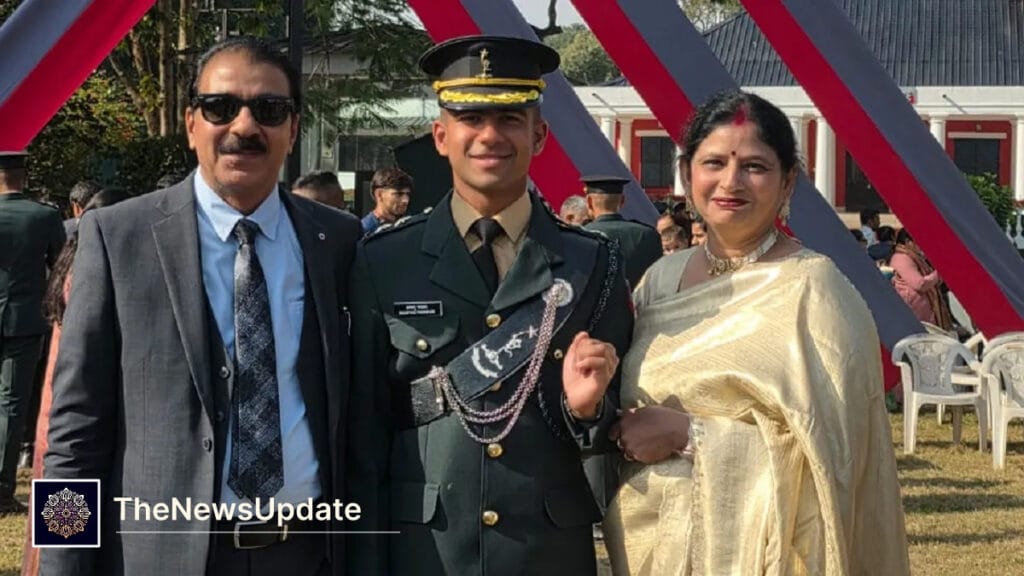
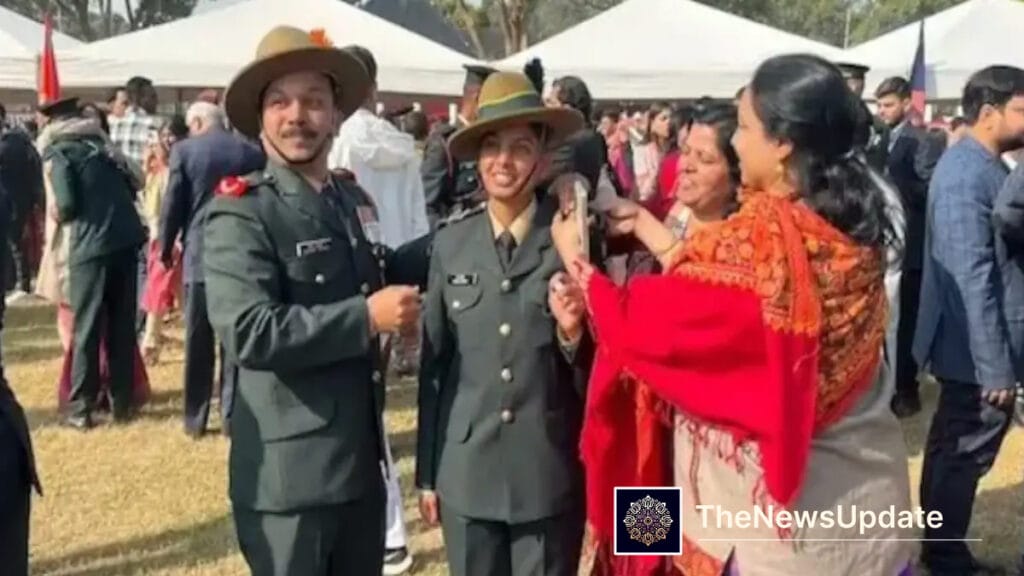
When her parents pinned the stars of a Lieutenant on her shoulders during the commissioning ceremony, it was more than a personal moment—it symbolised the continuity of a legacy that spans over a century.

Commissioned into the Territorial Army
Sai Jadhav has been commissioned as a Lieutenant in the Territorial Army, making her the first woman officer from the IMA to join this unique arm of the Indian Army. The Territorial Army allows citizens from civilian backgrounds to serve the nation while continuing their professional careers.
Although women have served in the Territorial Army through other commissioning routes, Sai’s distinction lies in being the first woman to graduate from the Indian Military Academy itself and then join the TA.
Defence analysts say this sets an important precedent. It demonstrates that training standards at IMA can be met by women officers and that institutional barriers are gradually giving way to merit-based inclusion.

The Training: No Concessions, No Shortcuts
Sai Jadhav underwent six months of intensive military training at the Indian Military Academy. Importantly, she trained alongside male officer cadets and was required to meet the same physical, academic, and leadership standards.
Her training included route marches, weapon handling, tactical exercises, classroom instruction on military law and strategy, and leadership assessments under pressure. Officials confirmed that there were no diluted norms or separate benchmarks.
This aspect of her journey has resonated strongly with veterans, many of whom have emphasised that equality in the armed forces must be rooted in uniform standards.
यह भी पढ़े:
 Canada Hospital Killed Indian-Origin Man: Wife Alleges Medical Negligence After 8-Hour Wait
The Road to IMA: Exams and Selection
Sai’s path to commissioning followed a rigorous selection process. After completing her graduation, she cleared a national-level examination that made her eligible for the Service Selection Board (SSB) interview.
The SSB process is considered one of the toughest military selection systems in the world, assessing candidates over several days for psychological aptitude, leadership qualities, physical endurance, and decision-making ability.
Her performance during the SSB earned her the rare opportunity to train at the IMA—an opportunity that required special permission given the academy’s historical framework.
Social Media Reaction and Public Response
News of Sai Jadhav’s achievement quickly spread across social media platforms, particularly X (formerly Twitter). Veterans, serving officers, defence analysts, and ordinary citizens hailed the moment as historic.
Many posts described her commissioning as an inspiration for young girls across the country. Others noted that the achievement reflects a broader transformation underway within the Indian Army.
Images of Sai in uniform, especially the moment when her parents pinned her stars, were widely shared and became emblematic of changing times.

Women in the Indian Army: A Gradual Evolution
The Indian Army’s journey toward greater inclusion of women has been incremental. Women were first inducted in non-combat roles in the early 1990s. Since then, avenues have gradually expanded to include permanent commissions, command roles in select branches, and training at premier institutions.
In 2022, the National Defence Academy (NDA) admitted women cadets for the first time. Currently, eight women officer cadets are undergoing training with the Indian Army as part of the first NDA batch to include women.
Sai Jadhav’s commissioning at the IMA complements these reforms and underscores the momentum building within the system.
Breaking the Psychological Barrier
Beyond policies and numbers, Sai’s achievement is significant for breaking a psychological barrier. The Indian Military Academy has long been seen as the ultimate symbol of traditional military leadership.
By successfully completing training there, Sai has challenged long-held assumptions about who belongs in such spaces. Defence experts say this could encourage institutional confidence in integrating women more fully across training and leadership pipelines.
What Lies Ahead for Sai Jadhav
As a newly commissioned officer in the Territorial Army, Sai Jadhav will now balance military responsibilities with civilian life. Like other TA officers, she will be embodied for training and operational duties as required.

In June 2026, she is expected to take part in a ceremonial parade in front of the Chetwode Building—an honour reserved for IMA graduates. That parade will serve as yet another visual reminder of a changed landscape.
Senior officers note that her future performance will be closely watched, not out of scepticism, but because she represents a new benchmark.
Why This Milestone Matters
Sai Jadhav’s commissioning matters because it demonstrates that institutional change is possible when opportunity meets preparedness. It reinforces the principle that leadership in uniform is defined by competence, discipline, and commitment—not gender.

For young women aspiring to serve the nation in uniform, her journey provides a tangible example of what is achievable. For the armed forces, it strengthens the case for continuing reforms that widen the talent pool without compromising standards.
A Moment That Redefines History
Since its founding in 1932, the Indian Military Academy has stood as a symbol of tradition, excellence, and service. With Sai Jadhav’s graduation, it also becomes a symbol of evolution.
Her achievement does not erase history—it builds upon it. It signals that the story of India’s armed forces is still being written, shaped by individuals willing to step into spaces once considered closed.

As the tricolour fluttered above the academy and the parade concluded, one truth stood clear: history had changed, not by decree alone, but by determination.
For continued updates on India’s fintech and digital finance developments, visit our Tech News section and The News Update.