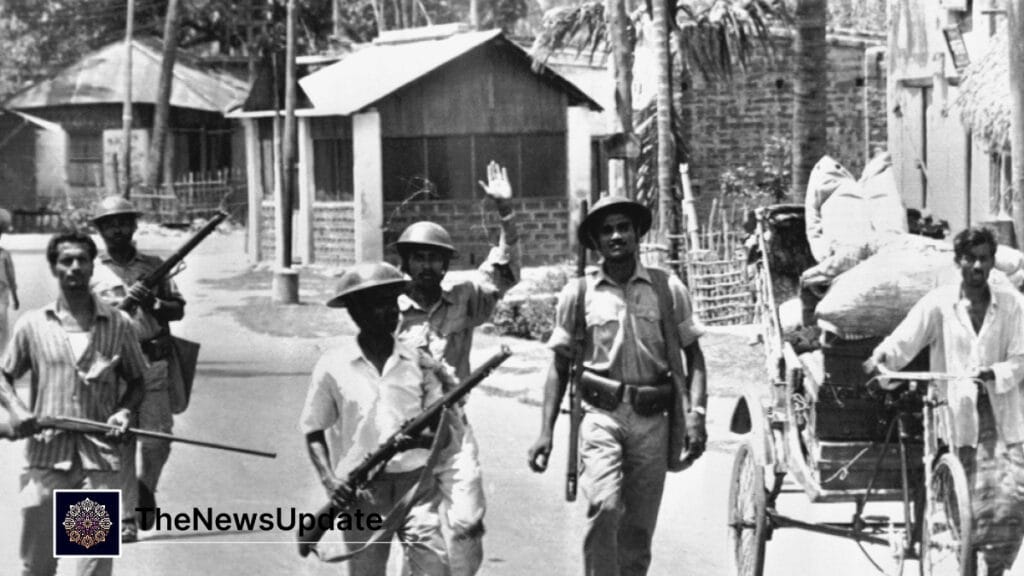
On December 16, 1971, Pakistan’s surrender in Dhaka was not merely a military defeat. It was the violent unravelling of a regime hollowed out by corruption, personal excess, and moral decay. As India celebrates Vijay Diwas, Pakistan’s own inquiry into the war continues to haunt its historical conscience.
Half the country was gone. Ninety-three thousand Pakistani soldiers became prisoners of war. The largest surrender since World War II forced Pakistan to ask a devastating question: how did this happen?
The answer, according to Pakistan’s own investigation, was more scandalous than the defeat itself.

The Hamoodur Rahman Commission: Pakistan’s Reckoning Pakistan 1971 war defeat
In the aftermath of the 1971 debacle, Pakistan’s new leader Zulfikar Ali Bhutto appointed Chief Justice Hamoodur Rahman to head a commission of inquiry. Its mandate was sweeping: identify why East Pakistan was lost, who was responsible, and what action should follow.
The commission’s findings were brutal. The Hamoodur Rahman Commission concluded that Pakistan did not lose the war simply due to Indian military superiority. It lost because its senior generals had succumbed to corruption, licentiousness, and moral degeneration.
The report stated that prolonged involvement in martial law had corroded professional ethics within the armed forces. Generals, it said, were more invested in wine, women, and personal enrichment than in command responsibilities.

Yahya Khan: A Drunk at the Helm
General Agha Muhammad Yahya Khan, Pakistan’s military dictator and commander-in-chief, emerged as a central figure in the commission’s narrative. By 1971, witnesses testified that Yahya’s Rawalpindi residence had become synonymous with heavy drinking and late-night parties.
As East Pakistan burned following Operation Searchlight and civil war escalated, urgent military cables reportedly went unanswered. Officers seeking instructions were turned away because the commander-in-chief was “indisposed”.
The commission argued that Yahya’s behaviour sent a fatal signal down the chain of command: if the head of state treated war as a distraction between cocktails, discipline elsewhere would inevitably collapse.

General Rani: Power Without Office
Akleem Akhtar, popularly known as “General Rani”, became the most infamous civilian figure of the regime. Though she held no official position, her proximity to Yahya Khan allegedly gave her extraordinary influence.
Business contracts, postings, promotions, and favours were said to pass through her hands. While not explicitly named in the commission’s harshest passages, her presence became symbolic of a system where personal relationships trumped institutional authority.
In Pakistan’s post-war folklore, General Rani came to represent how intimacy replaced accountability at the very top of power.
Noor Jehan and the Symbolism of Distraction
Another name woven into Pakistan’s post-1971 narrative was Noor Jehan, the country’s most celebrated singer. Even as the war raged, her patriotic songs dominated state radio.
Post-war accounts alleged that Noor Jehan spent nights at Yahya Khan’s residence during the critical months of the conflict. While never formally indicted, her presence became a metaphor for leadership distracted by entertainment while soldiers fought and died.
In the national imagination, the war was lost not in war rooms, but in drawing rooms filled with music and alcohol.

General Niazi: Collapse on the Battlefield
Lieutenant General AAK ‘Tiger’ Niazi, commander of Pakistan’s Eastern Command, became the face of defeat. His surrender in Dhaka symbolised the complete collapse of authority.
The Hamoodur Rahman Commission found Niazi guilty of conduct unbecoming of his rank. It cited repeated allegations of sexual immorality, corruption, and smuggling.
Most damning was testimony that Niazi’s behaviour destroyed discipline among troops. Soldiers reportedly remarked that if their commander himself committed sexual crimes, how could restraint be expected from the ranks?

The commission argued that moral rot at the top directly translated into operational failure on the ground.
Moral Collapse Over Military Failure
The commission’s central thesis was stark: Pakistan lost the 1971 war because its leadership lost its moral compass. Wine, women, and corruption were not side stories—they were central to the breakdown of command.
At the same time, this explanation served a political purpose. By blaming personal vices, Pakistan avoided confronting deeper issues: the brutality in East Pakistan, denial of democratic mandate, ethnic discrimination, and the structural impossibility of ruling a divided nation.

No Accountability, Only Scapegoats
Despite the commission’s recommendations, neither Yahya Khan nor Niazi faced a full public trial. Yahya resigned and lived under house arrest before dying quietly in 1980.
Niazi was retired and disgraced but never court-martialled. He later claimed he was made a scapegoat while others were protected. The most damning portions of the commission’s report remained suppressed for decades.
Pakistan’s reckoning with 1971 was ultimately incomplete. The generals were shielded. The institution survived. The lessons remained largely unlearned.
The Lingering Hangover of 1971
As India commemorates Vijay Diwas, Pakistan’s own inquiry stands as a cautionary tale. Nations do not collapse only because of enemy action. They collapse when leadership abandons responsibility for indulgence.
Yahya Khan was indeed drunk while his nation fell apart. More than five decades later, Pakistan still lives with the hangover.
For continued updates on India’s fintech and digital finance developments, visit our Tech News section and The News Update.

By The News Update — Updated December 16, 2025