Table of Contents
- Quick summary
- How JWST made a 3D map (eclipse mapping)
- What the 3D map reveals about WASP-18b
- Why water is breaking down at 2,760°C
- Scientific implications and future prospects
- Further reading & sources
Quick summary
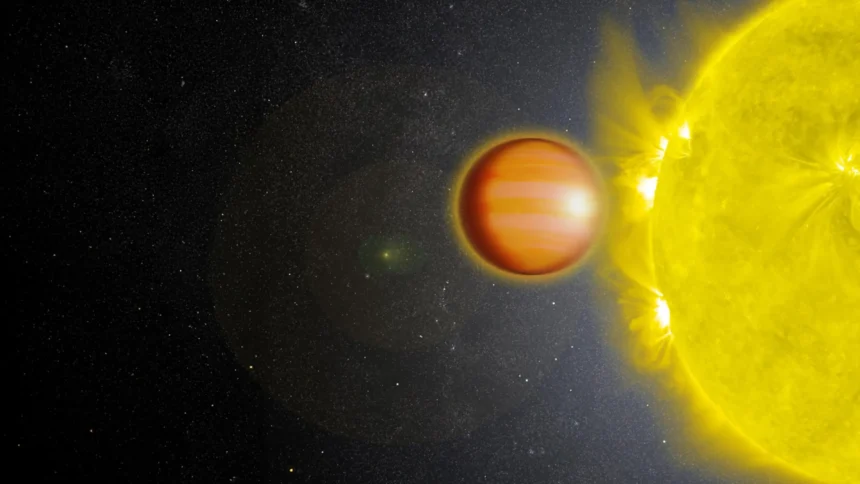
NASA’s James Webb Space Telescope (JWST) exoplanet WASP-18b has produced the first-ever three-dimensional atmospheric map of an exoplanet — the ultra-hot Jupiter WASP-18b, roughly 400 light-years away. Using a technique called 3D eclipse mapping with JWST’s near-infrared instruments, researchers reconstructed temperature variations at different atmospheric depths and found a blistering dayside “hotspot” so extreme that water vapor appears to be dissociating under intense starlight. This milestone opens a new window into exoplanet climates and demonstrates JWST’s unique power to probe atmospheres in three dimensions.
How JWST made a 3D map (eclipse mapping)
The mapping method is an extension of eclipse mapping and spectroscopy. As WASP-18b moves behind its star (secondary eclipse), JWST’s instruments — notably the Near-Infrared Imager and Slitless Spectrograph (NIRISS) — recorded how the planet’s emitted light at many wavelengths dipped and recovered. Each wavelength probes a different pressure level (altitude) in the planet’s atmosphere, because molecules like water absorb in specific bands. By combining time-resolved spectral light curves across wavelengths, scientists can invert the data to reconstruct a three-dimensional temperature structure: longitude, latitude and vertical profile. This “spectroscopic eclipse mapping” is the core innovation behind the result.

What the 3D map reveals about WASP-18b
WASP-18b is an extreme world — about 10 times Jupiter’s mass and tidally locked, completing an orbit in roughly 23 hours. The JWST 3D map reveals:
- A concentrated dayside hotspot: The brightest, hottest region sits near the substellar point (the area facing the star) and reaches temperatures of order ~2,760 °C (about 5,000 °F) exoplanet WASP-18b.
- Clear vertical structure: Different wavelengths map different altitudes, so the team could see how temperature varies with height — a true 3D view rather than a surface-only snapshot exoplanet WASP-18b.
- Water depletion in the hotspot: At wavelengths where water absorption dominates, the hotspot appears markedly fainter, implying reduced water vapor — consistent with thermal dissociation of H2O at these extreme temperatures.
- A surrounding cooler ring: The hotspot is framed by a cooler annulus, reflecting the planet’s steep dayside–nightside contrast owing to tidal locking and inefficient heat redistribution exoplanet WASP-18b.
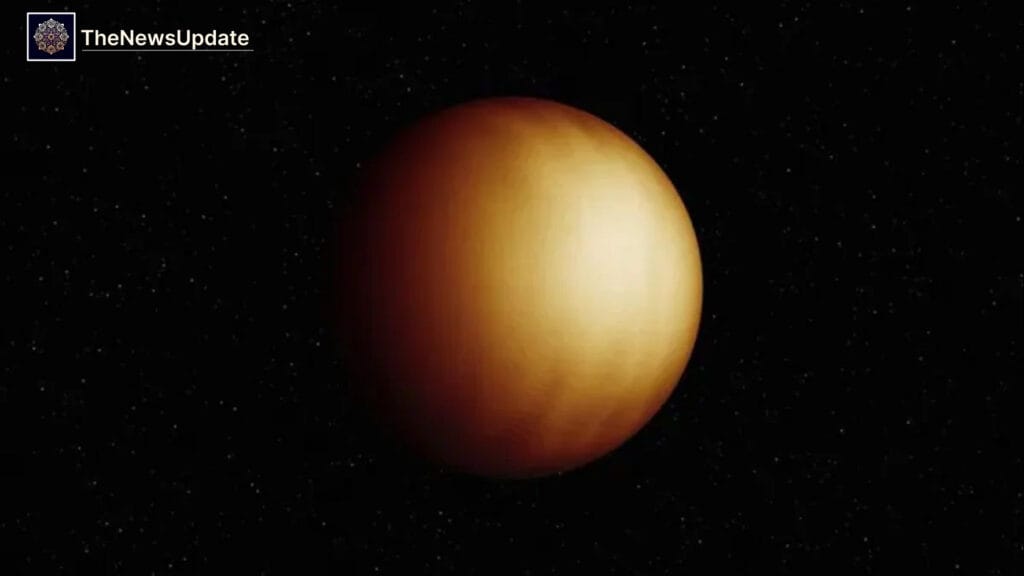
That combination — a blistering core, a cooler ring, and vertical gradients — is precisely what theory predicted for ultra-hot Jupiters but had never before been imaged in 3D. The map validates models and supplies crucial constraints for atmospheric circulation and chemistry simulations. :
Why water is breaking down at 2,760°C
At temperatures of several thousand degrees Celsius, molecular bonds cannot survive. Water (H2O) begins to thermally dissociate into hydrogen and oxygen atoms or smaller molecules. On WASP-18b’s dayside hotspot, the energy input from the nearby star is so intense that water molecules are partially destroyed, removing their spectral signatures at the relevant infrared wavelengths. The team’s detection of a weakened water signal in the hotspot is therefore interpreted as direct evidence of thermal dissociation — an effect long predicted in ultra-hot atmospheres but now observed in 3D.

Scientific implications and future prospects
This achievement is more than a single spectacular image — it ushers in a new observational capability with several important outcomes:
- Population-level atmospheric studies: If 3D eclipse mapping can be applied to many hot Jupiters, astronomers will compare vertical and horizontal thermal structures across a population and test models of circulation, dissociation chemistry, and energy transport. WASP-18b is a proof of concept.
- Confronting climate models: Global circulation models (GCMs) make detailed predictions about jet streams, heat redistribution, and vertical mixing. 3D maps supply the spatially and vertically resolved data needed to validate and refine those models.
- Accessing composition at altitude: By comparing absorbing and non-absorbing wavelengths, researchers can map where molecules survive or dissociate — a direct probe of chemistry under extreme irradiation. This is crucial for understanding atmospheric escape, cloud formation and elemental abundances.
- Pathway to smaller worlds: Authors of the study note that improved spatial resolution and repeated observations could extend eclipse-mapping techniques toward smaller, potentially rocky exoplanets, though that remains a more distant goal given signal limits.
Practically, the next steps include longer JWST programs to increase signal-to-noise, applying the method to different planet classes, and coordinating multi-instrument campaigns (for instance, combining NIRISS with MIRI and NIRSpec) to widen spectral coverage and deepen vertical sampling.
Further reading & sources
- NASA’s JWST Produces First-Ever 3D Map of WASP-18b.
- Space.com — Scientists use JWST to make 1st 3D map of an exoplanet.
- EurekAlert/Cornell — UMD astronomer co-leads creation of first 3D temperature map of a distant exoplanet.
Updated November 3, 2025. Edited and expanded for The Morning News Informer.