Table of Contents
- Introduction
- Origins: Laveretsky, Kasli Casting and 1896
- 1900 Paris Exhibition and the French Offer
- Replicas, the Kremlin Copy and the Yekaterinburg Original
- Symbolism: What “Mother Russia” Means
- Modern Presence: Ekaterina Hall & Putin’s Interview
- Conclusion: Art, Memory and National Identity
- Related Reads
Introduction
The Mother Russia Statue Behind Putin that dominated the background of a recent India Today interview is not a prop — it is a carefully preserved piece of Russian cultural history. Cast in the late 19th century and celebrated at the Paris World Exhibition of 1900, the sculpture represents a through-line between imperial Russian art and the nation’s contemporary self-image.
Origins: Laveretsky, Kasli Casting and 1896
The statue commonly referred to as “Russia” or “Mother Russia” was created by sculptor N.A. Laveretsky and first cast for the All-Russian Exhibition in Nizhny Novgorod in 1896. The work was crafted using the Kasli cast-iron technique — a hallmark of Ural metalwork known for its fine detail and surprising durability. Kasli castings combined artistic finesse with industrial skill, making the pieces both decorative and robust.

Laveretsky’s composition presents a robed, armoured female figure with a sword and shield — a classical martial personification of the nation — but rendered with late-19th-century academic subtlety rather than grandiose gigantism. This balance of detail and symbolism helped the piece stand out in international exhibitions.
1900 Paris Exhibition and the French Offer
When the Kasli pavilion — an entire display of cast-iron artistry — travelled to the 1900 Paris World Exhibition, it became one of the fair’s highlights. The pavilion itself, designed by architect E. Baumgarten, won awards and public attention; at its heart stood the Russia statue.
French President Émile Loubet reportedly offered to buy the entire pavilion and its works for a sum equivalent to two million rubles — an enormous offer at the time. While many pieces were negotiable, museum records and contemporary accounts indicate that the owners refused to sell the Russia statue itself. When a later private bid of 20,000 rubles surfaced for that specific figure, Russian representatives reiterated the refusal, reportedly saying in effect, “Russia is not for sale.” This anecdote became part of the statue’s modern lore.
Replicas, the Kremlin Copy and the Yekaterinburg Original
After the Paris exhibition concluded, the original cast returned to Russia and was preserved. A bronze copy was produced in 1900, and only a handful of replicas were ever made. One of these replicas now stands in the Kremlin’s Ekaterina (Catherine) Hall, while the original is housed in a museum in Yekaterinburg (Ekaterinburg) in Russia’s Ural region. These multiple versions explain why the statue is familiar on both national and official stages.
Symbolism: What “Mother Russia” Means
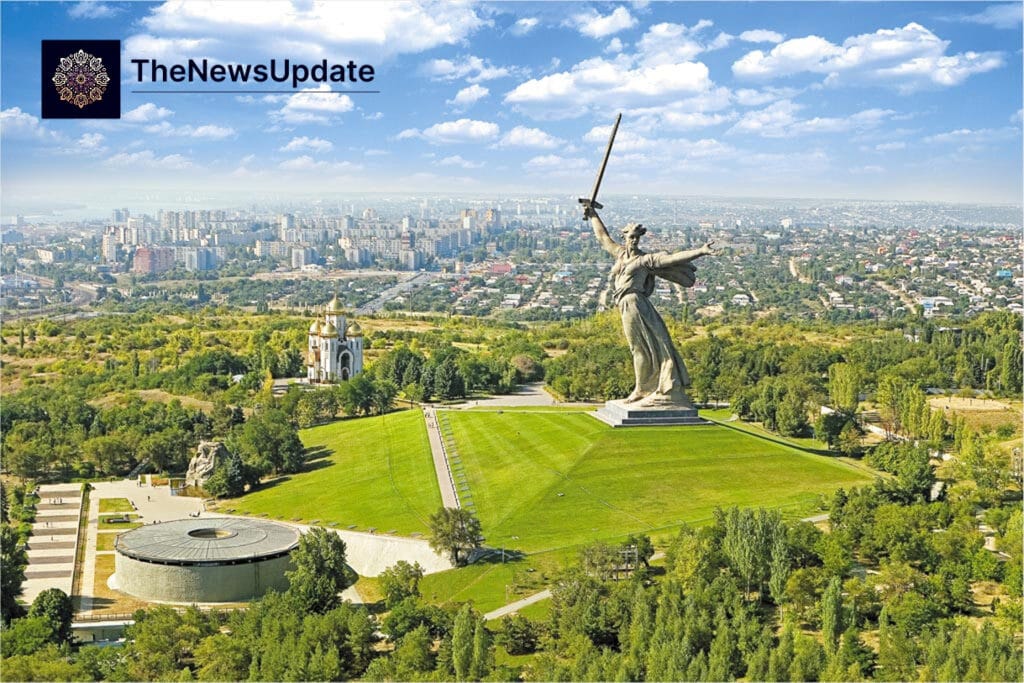
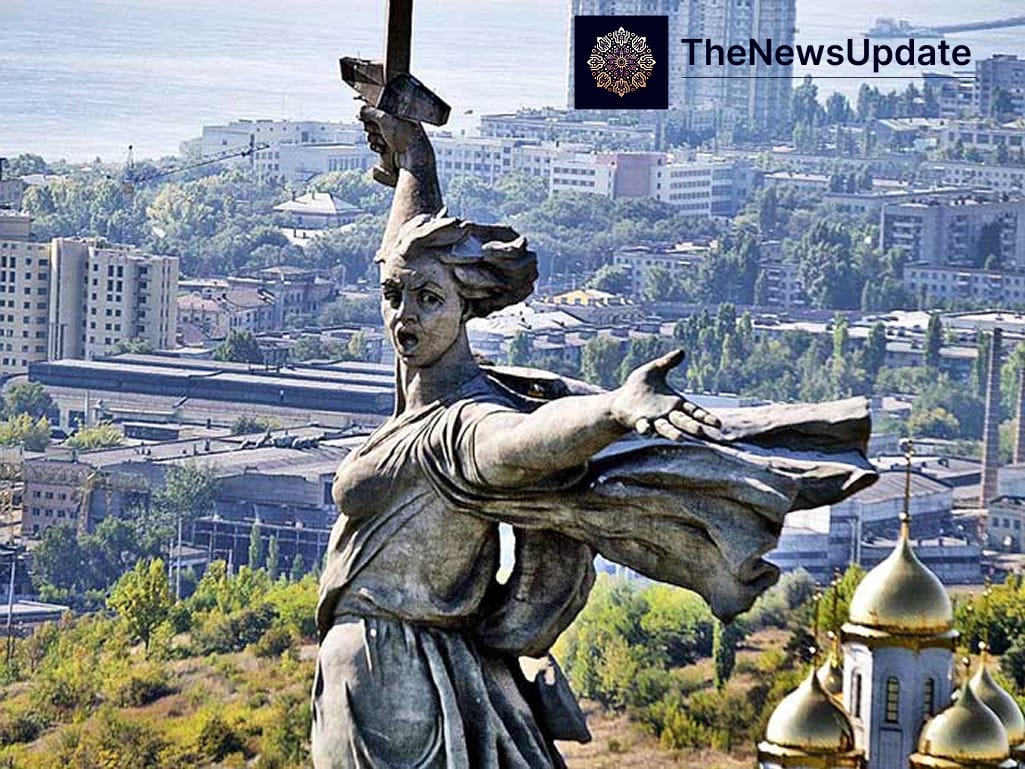
The iconography of a robed woman with a sword is familiar in many cultures as a national personification — but in the Russian context it carries layered meanings. The figure merges protective strength with maternal guardianship, suggesting a homeland that protects its people while demanding resilience. That synthesis of maternal and martial attributes has made Mother Russia a recurring motif in Russian public art, from 19th-century academic pieces to Soviet war memorials like The Motherland Calls in Volgograd.
Because the statue predates the Soviet era, it is also a rare cultural artifact that links Tsarist artistic tradition with modern state narratives. That historical continuity amplifies the statue’s symbolic weight: it can be read as both a national archetype and an object of official heritage.

Modern Presence: Ekaterina Hall & Putin’s Interview
In recent years the Ekaterina Hall has been the setting for high-profile diplomatic meetings and state events. When India Today interviewed President Vladimir Putin, the replica of the Russia statue was positioned conspicuously behind him — visible to millions of viewers worldwide. For many, it served as more than decorative theatre: it was a deliberate staging choice that invoked history, sovereignty, and continuity.
The modern Kremlin — a highly choreographed stage for power — often uses art and architecture to send subtle signals. Placing a national personification behind a head of state can suggest protective lineage, cultural legitimacy, and an appeal to historical memory. In an age of visual politics, such decisions carry meaning beyond aesthetics.
Quick facts about the statue
- Created by N.A. Laveretsky and first cast in 1896 for the All-Russian Exhibition in Nizhny Novgorod.
- Displayed at the 1900 Paris World Exhibition inside the Kasli cast-iron pavilion.
- French President Émile Loubet expresssed interest, but the statue was not sold.
- Original is preserved in Yekaterinburg; a rare replica stands in the Ekaterina Hall at the Kremlin.
Conclusion: Art, Memory and National Identity
The Mother Russia Statue Behind Putin is a compact story of artistry, national pride and the politics of cultural heritage. From Kasli foundries to a Parisian world fair, and from diplomatic offers to a modern Kremlin stage, the object has moved through contexts that have expanded its significance. Its refusal to be sold at the Paris fair — whether read literally or as a symbolic anecdote — now reads like a founding myth for an object that continues to represent Russia to both domestic and international audiences Mother Russia Statue Behind Putin.

Related Reads
By The Morning News Informer — Updated 4 December 2025