ISRO’s Gaganyaan parachute drop test capsule achieved another major milestone as it successfully completed a parachute drop test from an altitude of 2.5 km, marking a crucial step toward India’s first human spaceflight mission. Conducted on November 3, 2025, this test validated the performance and reliability of the capsule’s 10-chute landing system, ensuring astronaut safety during re-entry and descent.
The Indian Space Research Organisation (ISRO) confirmed that the Gaganyaan parachute drop test was executed flawlessly, further solidifying India’s growing capabilities in advanced space technologies. This successful demonstration places India closer than ever to launching its first crewed space mission — a goal that has been in the making for over a decade.
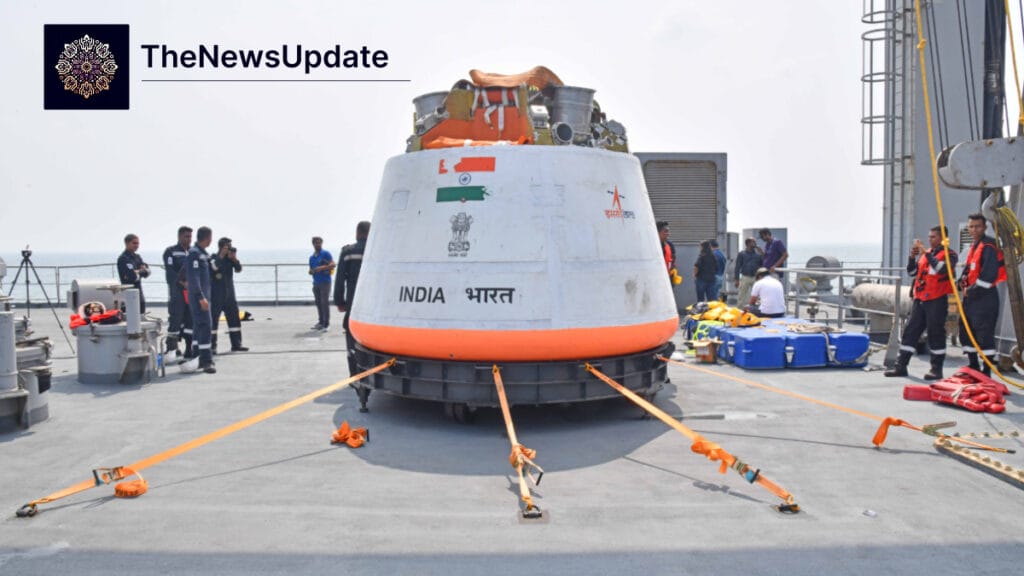
Testing Gaganyaan’s Parachute System
According to ISRO, the Gaganyaan capsule features a sophisticated array of 10 parachutes designed to ensure a stable descent and safe touchdown. The sequence involves:

- Two chutes to jettison the capsule’s protective cover,
- Two drogue parachutes for stabilization and deceleration,
- Three pilot chutes to deploy the main canopies, and
- Three main parachutes responsible for the final landing sequence.
The November 3 test, conducted using an Indian Air Force IL-76 aircraft over Uttar Pradesh, simulated an “off-nominal” scenario — meaning only two of the three main parachutes were intentionally deployed to test the capsule’s response under asymmetric load conditions. Despite the uneven deployment, the module achieved a stable descent and soft landing, confirming the system’s robustness and redundancy.
ISRO engineers described the results as “an essential validation for astronaut safety” and a key step in qualifying the Gaganyaan parachute system for operational use. This achievement underscores India’s growing expertise in developing complex space recovery technologies comparable to those used by NASA and Roscosmos.
Why the Parachute Test Matters
For any human spaceflight program, the parachute system is among the most critical safety components. It ensures that astronauts re-entering Earth’s atmosphere can safely decelerate from supersonic speeds to a soft landing. Even a single malfunction could result in mission failure.

The successful test not only verifies the engineering but also boosts confidence in India’s space mission safety protocols. With this, ISRO joins an elite group of space agencies — including NASA, SpaceX, and ESA — that have validated advanced multi-stage parachute systems for crew recovery.
In addition, the test results provide valuable data that will be used to fine-tune the final configuration before the manned mission. ISRO stated that all onboard sensors and telemetry systems performed as expected, capturing real-time descent data for further analysis.
Next Steps for India’s Crewed Mission
Following this success, ISRO is preparing for a series of uncrewed Gaganyaan missions to test other vital systems, including life-support, navigation, and communication modules. One of the upcoming flights will carry Vyomitra — a humanoid robot designed to simulate human physiological responses in space.

Vyomitra, meaning “space friend,” will serve as a test passenger to monitor the spacecraft’s environmental systems. If all goes according to plan, India’s first astronauts may embark on a crewed Gaganyaan mission as early as 2027. The mission aims to send a three-member crew to low Earth orbit (LEO) for up to seven days before safely returning to Earth.
ISRO has emphasized that every test — including the parachute drop — is essential to meet international safety standards. The agency reaffirmed its commitment to ensuring “zero compromise on astronaut safety.”
Broader Significance of Gaganyaan
The Gaganyaan program symbolizes India’s transition from a satellite-launching nation to a human spaceflight-capable power. The success of these milestones not only strengthens India’s position in global space exploration but also opens doors to potential collaborations with other agencies, including NASA and the European Space Agency (ESA).
यह भी पढ़े:
 Samsung Bixby Perplexity AI Integration: 7 Key Signs Samsung Is Reinventing Its Voice Assistant
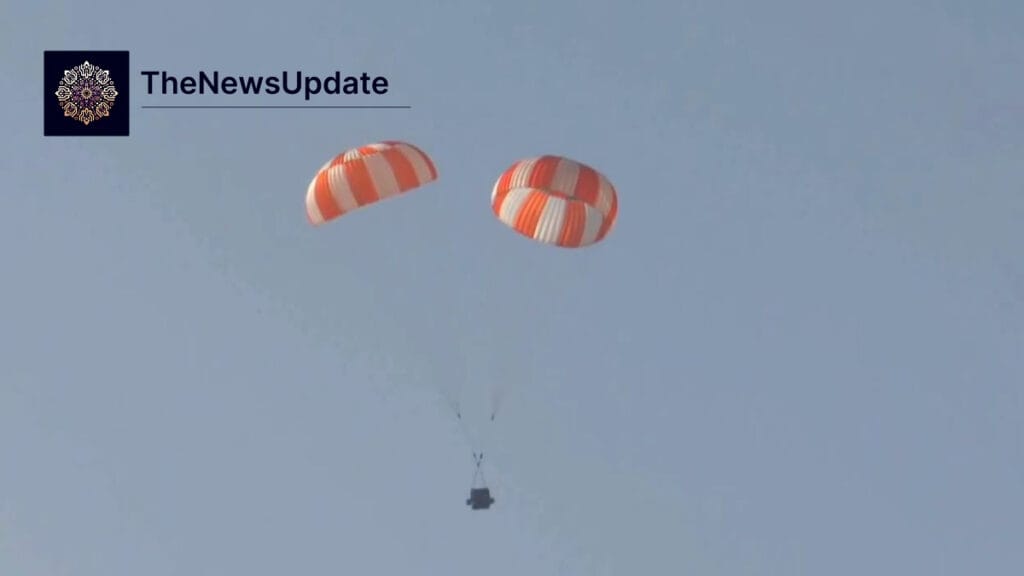
Economically, Gaganyaan could catalyze innovation within India’s growing space ecosystem, empowering private aerospace companies and startups. It also bolsters India’s technological self-reliance in critical sectors such as avionics, propulsion, and life-support systems.
Conclusion
The successful Gaganyaan parachute drop test is a testament to India’s dedication and engineering excellence in space technology. With each milestone, the nation inches closer to making history by launching its first astronauts into space. As ISRO continues its series of uncrewed missions, optimism is building that India’s long-awaited human spaceflight mission could soon become a reality.
Stay updated with more on ISRO’s latest missions and India’s space achievements on The Morning News Informer and The News Update.

Key Takeaways:
- ISRO successfully conducted the Gaganyaan parachute drop test on November 3, 2025.
- The test simulated off-nominal conditions to ensure safety in case of partial parachute deployment.
- The system worked flawlessly, validating the landing sequence and descent stability.
- India’s first crewed spaceflight is expected by 2027 following multiple uncrewed trials.