Table of Contents
- Background of the Haryana Doctor Terror Module Investigation
- How the Detention in Anantnag Unfolded
- Links to Red Fort Blast & Wider Network
- Role of Medical Professionals in White-Collar Modules
- Nationwide Crackdown Across States
- What Investigators Believe Happened
- What’s Next in Haryana Doctor Terror Module Investigation
- Related Reads
Background of the Haryana Doctor Terror Module Investigation
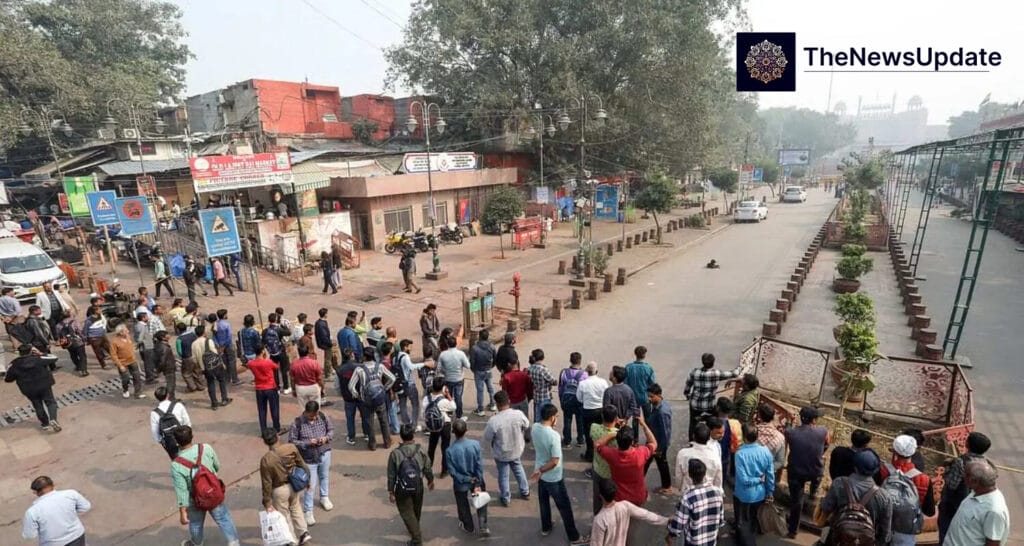
The Haryana doctor terror module investigation has rapidly become one of India’s most unsettling and complex counter-terror probes in recent years. What began as an inquiry into a suspected logistics cell has now unfolded into a multi-state conspiracy involving medical professionals, students, and individuals with seemingly respectable social profiles—hence the term “white-collar terror module.”
Officials initially suspected that radicalised elements were spreading across several institutions. But the probe intensified dramatically after the deadly Red Fort blast that killed 13 people earlier this month. Early leads suggested a coordinated logistics, financing and planning network operating silently across different states. As more arrests were made, investigators began uncovering unusual patterns of involvement among individuals in medical and academic fields.
यह भी पढ़े:
 Osman Hadi Killers Fled to India via Meghalaya Border: Dhaka Police Reveal Shocking Escape Route
It is within this expanding landscape that the detention of a woman doctor from Haryana—posted at GMC Anantnag—has added a new dimension to the ongoing investigation.
How the Detention in Anantnag Unfolded
On Thursday, counter-intelligence teams of the Jammu & Kashmir Police conducted a targeted raid in the Malaknag area of Anantnag. The action led to the detention of Dr Priyanka Sharma, a medical professional from Rohtak, Haryana, currently serving at the Government Medical College (GMC) Anantnag.
Her detention stemmed from crucial revelations made after the arrest of Adeel, a former GMC staffer. Investigators examining his call-detail records found repeated contacts linked to Dr Sharma’s location. The interrogation reportedly indicated that she might have been in communication with individuals suspected of providing financial or logistical assistance to the module.
यह भी पढ़े:
 Bulldozer Raj Karnataka Demolitions: Congress Govt Faces Backlash After 400 Muslims Left Homeless
A mobile phone and SIM card seized from her rented accommodation have been sent for forensic evaluation. Authorities expect this digital evidence to become a cornerstone of the wider Haryana doctor terror module investigation.
Officials from Haryana are expected to reach Anantnag soon to conduct background verification and parallel inquiries in her home district.
Links to Red Fort Blast & Wider Network
The detention is deeply interconnected with the ongoing investigation into the Red Fort blast—a coordinated incident that shocked the nation and prompted a large-scale response from central agencies. Three individuals, including two doctors from Haryana’s Al-Falah University, were arrested last week by Delhi Police.

Initial questioning revealed that both detained doctors had prior contact with Dr Muzammil Ganaie, already arrested in the “white-collar” module case. Their links to Umar Nabi—the driver of the Hyundai i20 that exploded—strengthened suspicions that an academic network was being exploited for covert operations.
Notably, one of the arrested doctors was in Delhi on the day of the blast for an AIIMS interview, raising speculation about whether the timing was coincidental or part of planned logistical cover.
Role of Medical Professionals in White-Collar Modules
One of the most alarming aspects of the Haryana doctor terror module investigation is the repeated emergence of highly educated individuals as suspects or persons of interest. According to intelligence officials, the use of medical students, professionals and academically-linked individuals serves multiple strategic purposes:
- They attract less suspicion due to social respectability
- They have access to sensitive institutional spaces
- Their academic mobility makes cross-state travel appear normal
- They often have the financial means to support covert operations
The involvement of doctors in particular also grants the module a logistical backbone—greater network access, controlled interactions and the ability to mask communication trails.
Nationwide Crackdown Across States
The investigation has triggered sweeping actions in Uttar Pradesh, Haryana, Delhi and Jammu & Kashmir. Around 200 Kashmiri-origin medical students studying in UP have come under the radar. Universities and colleges across Lucknow, Kanpur, Meerut, Saharanpur and other cities have been asked for attendance logs, hostel entries and background verification details.
In Haryana, a man named Dinesh alias Dabbu was detained for allegedly supplying fertiliser used in the blast. Police believe members of the module pooled approximately ₹26 lakh to procure explosive materials—₹3 lakh of which was spent on NPK fertiliser. Investigators are probing whether Dabbu’s illegal sales extended beyond unlicensed fertiliser distribution into deliberate collaboration.
यह भी पढ़े:
 Canada Hospital Killed Indian-Origin Man: Wife Alleges Medical Negligence After 8-Hour Wait
In Delhi, Crime Branch teams have registered FIRs against Al-Falah University for forgery and cheating after UGC and NAAC flagged severe irregularities. Whether the university’s administrative loopholes were exploited intentionally by the module is now part of the larger inquiry.
What Investigators Believe Happened
According to multiple agencies, the white-collar module appears to function through:
- Academic and professional infiltration
- Layered logistics support
- Financial pooling through anonymous channels
- Use of legitimate travel and academic events as operational cover
- Decentralised communication to avoid detection
Digital forensics, call-detail matching and CCTV analysis are now central to identifying where each suspect fits into the puzzle. Every movement of Umar Nabi—before and after the blast—is being traced, including his stop at a tea stall in Wazirpur Industrial Area and the hours his car remained parked at Sunehri Masjid.
What’s Next in Haryana Doctor Terror Module Investigation
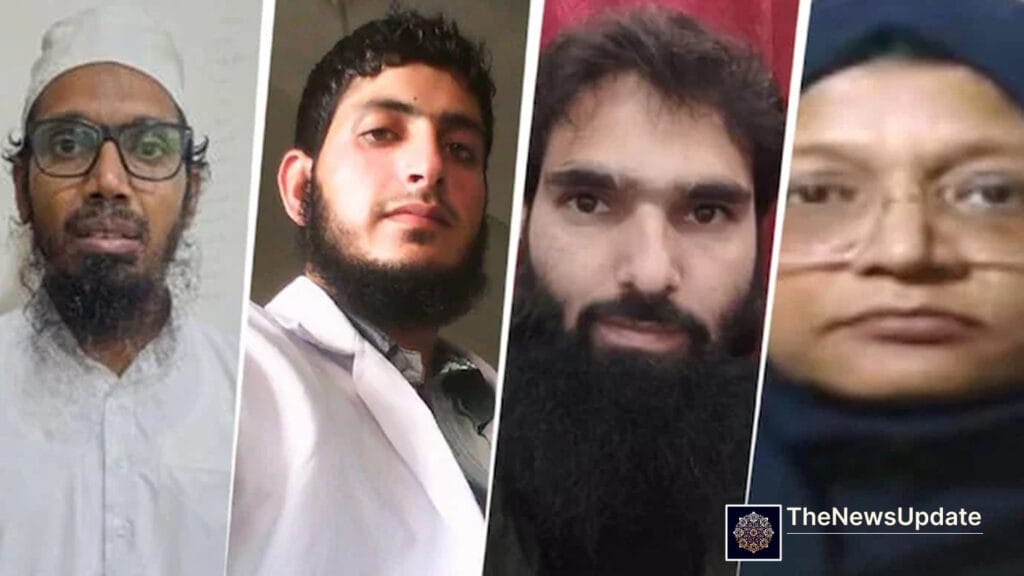
Now that multiple professionals have been detained or arrested across states, central agencies—particularly the NIA—are expected to take over the broader conspiracy probe. Their objective will be to:
- Assess international linkages
- Verify academic radicalisation networks
- Investigate institutional vulnerabilities
- Uncover long-term planning or recruitment pipelines
The detention of the Haryana doctor marks a significant escalation in the Haryana doctor terror module investigation, suggesting a deeper and more organised ecosystem than initially believed.
Related Reads
By The Morning News Informer — Updated Nov 16, 2025