Google is reportedly preparing a major shift in its operating system lineup with the development of Aluminium OS, a next-generation platform designed specifically for laptops, tablets, and premium commercial devices. According to recently discovered job listings, the new OS—internally referred to as ALOS—will merge the best features of ChromeOS with Android while placing artificial intelligence at its core. This ambitious move reflects Google’s expanding vision to build AI-first experiences across every device category.
Table of Contents
- What is Google Aluminium OS?
- Job Listing Confirms Google’s ALOS Development
- Why Google Is Merging Android and ChromeOS
- AI-Powered Features Expected in Aluminium OS
- How Aluminium OS Could Replace ChromeOS
- Impact on Google’s Ecosystem
- The Qualcomm Connection and Android 16 for PCs
- What This Means for PC Users
- Conclusion
What is Google Aluminium OS?
Google Aluminium OS (ALOS) is an upcoming Android-based operating system tailored for laptops, tablets, and detachable hybrid devices. Unlike ChromeOS—which is optimized for web-first workflows—ALOS is expected to be more powerful, AI-centric, and capable of delivering deeper integration with Android’s app ecosystem. The OS will reportedly support next-generation PC hardware, including devices equipped with AI-accelerated chipsets.

The development of Aluminium OS signals Google’s intention to enter the competitive PC operating system market dominated by Windows and macOS. But unlike traditional systems, ALOS is being built as an AI-first OS, capable of handling advanced machine-learning workflows, on-device processing, and adaptive user experiences powered by Google’s growing suite of AI technologies.
Job Listing Confirms Google’s ALOS Development
The surge of rumours around Aluminium OS became significantly stronger after a critical job posting surfaced on LinkedIn. In the listing, Google sought a Senior Product Manager, Android, Laptop and Tablets, based in Taipei, Taiwan. Although the listing has now closed, it provided clear confirmation regarding the ongoing development of ALOS.
The role’s description stated that the new executive would oversee the development of “ChromeOS and Aluminium Operating System (ALOS) Commercial devices across all form factors.” This single line effectively confirms that:
- Google has already begun work on Aluminium OS.
- It will be launched across multiple device categories.
- It may become Google’s future flagship OS for PCs.
Moreover, the listing emphasized that ALOS will be engineered with “AI at its core”, reinforcing Google’s broader ambition to integrate AI deeply across its hardware and software platforms.
Why Google Is Merging Android and ChromeOS
Android powers billions of phones, tablets, smart TVs, and AR/VR headsets worldwide. ChromeOS, meanwhile, has carved out a strong niche in education and lightweight productivity markets. But maintaining two separate platforms has created several challenges for Google:
- Developers must optimize apps twice—once for Android, once for ChromeOS.
- ChromeOS lacks Android’s robust app ecosystem despite compatibility layers.
- Android alone is not optimized for large-screen productivity on laptops.
- AI adoption requires unified architecture for smooth cross-device integration.
Aluminium OS aims to solve these problems by combining the strengths of both systems into a single high-performance platform. ALOS is expected to deliver Android’s app richness, ChromeOS’s streamlined performance, and a powerful AI-driven toolkit suited for future devices.

AI-Powered Features Expected in Aluminium OS
Google has not officially revealed Aluminium OS features, but its focus on AI suggests the OS will adopt many next-generation capabilities, including:
- On-device AI assistants powered by Gemini Nano or future Google AI models.
- Context-aware automation that adjusts system behavior based on user habits.
- Real-time language translation for text, speech, and even UI elements.
- AI-enhanced multitasking for productivity-focused workflows.
- Generative AI tools integrated directly into system apps like Files, Notes, and Photos.
- Better adaptive battery and power management driven by machine learning.
- AI-based security features for threat detection and device protection.
With these features, Google Aluminium OS could become one of the most advanced AI-centric operating systems available on consumer hardware.
How Aluminium OS Could Replace ChromeOS
Within the job listing, Google mentioned the need to:
यह भी पढ़े:
 Samsung Bixby Perplexity AI Integration: 7 Key Signs Samsung Is Reinventing Its Voice Assistant
“strategise Google’s transition from ChromeOS to Aluminium with business continuity in the future.”
This line strongly implies that Google may gradually phase out ChromeOS and shift toward ALOS as its primary laptop operating system. The transition could take several years, starting with premium devices before moving to Chromebook and Chromebook Plus categories.
The move is unsurprising for several reasons:

- ChromeOS is limited by its web-first model.
- AI-powered hardware requires deeper OS-level integration.
- Android apps run better on an Android-based system.
- The PC market is moving toward hybrid AI-powered platforms.
If successful, Aluminium OS could position Google as a stronger competitor to Microsoft’s AI-powered Windows and Apple’s macOS.
Impact on Google’s Ecosystem
The launch of Aluminium OS will reshape Google’s entire product ecosystem. The OS will likely integrate with:
- Android’s existing app library
- ChromeOS’s cloud-first services
- Google Workspace and enterprise systems
- Google Play Services and app distribution pipelines
This unified platform will give Google more control over device experiences, reduce fragmentation, and support advanced AI workflows across all supported form factors.
यह भी पढ़े:
 New York Times Reporter, Authors Sue Google, OpenAI, Meta Over AI-Based Copyright Infringement
The Qualcomm Connection and Android 16 for PCs
Recent reports confirm that Qualcomm is working closely with Google to bring Android 16 to PCs powered by Snapdragon X and Snapdragon X Elite chipsets. These chips are AI-optimized and capable of supporting desktop-class performance.
Qualcomm’s new platform aims to “converge mobile and desktop computing,” which aligns perfectly with Google’s Aluminium OS strategy. This collaboration suggests that future ALOS devices may run on Qualcomm’s powerful NPU-equipped processors, leading to:
- Faster on-device AI processing
- Better energy efficiency
- Improved thermal performance
- Superior mobile-desktop compatibility
As both companies push toward hybrid computing, ALOS could become the default OS for next-gen AI PCs.
What This Means for PC Users
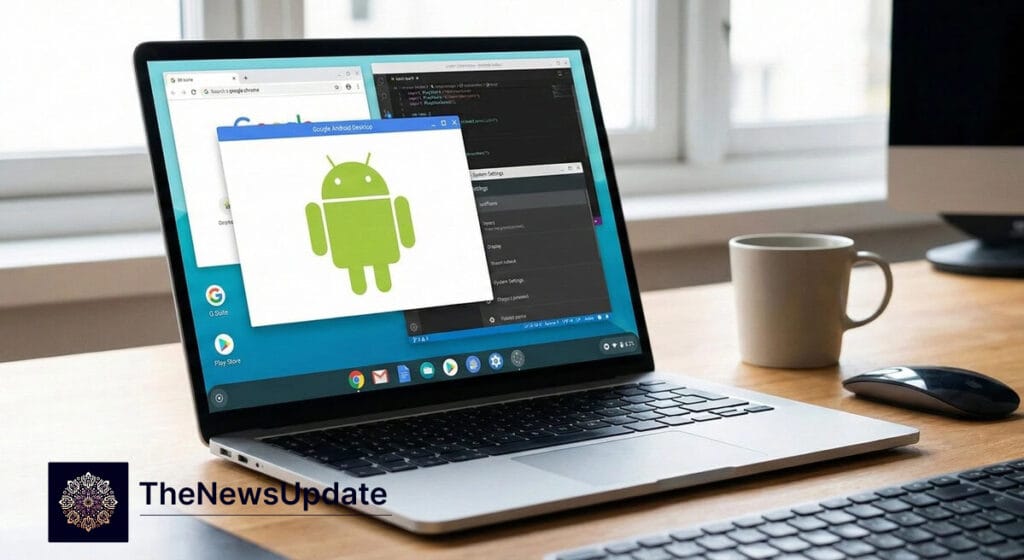
For consumers and professionals, the introduction of Google Aluminium OS could unlock several advantages:
- Better performance through AI-driven optimization.
- Richer app ecosystem with native Android support.
- Smoother multitasking suited for productivity and creative workflows.
- Access to Google’s AI suite, including generative and predictive tools.
- Tight integration across phones, tablets, and laptops.
- More affordable AI-powered hardware than Apple or Windows machines.
For enterprise users, ALOS may offer enhanced security, better remote management, and powerful cloud integration.
Conclusion
Google Aluminium OS represents one of the company’s most significant operating system initiatives in years. By integrating Android strengths, ChromeOS efficiency, and next-generation AI capabilities, ALOS is poised to redefine the future of AI-powered computing across laptops, tablets, and commercial devices. Although Google is yet to announce an official launch timeline, the confirmed job listings and industry partnerships indicate rapid progress behind the scenes.
यह भी पढ़े:
 Indie Band Claims AI Stole Their Billie Eilish Cover, Raising Fresh Fears Over Music Copyright
As the PC industry moves toward hybrid AI-first platforms, Google Aluminium OS could emerge as a strong competitor—possibly even replacing ChromeOS in the long run. With Qualcomm collaborations, Android 16 readiness, and powerful AI tools at its foundation, ALOS may become a major turning point in Google’s operating system strategy.