Table of Contents
- Background of the G20 Summit 2025
- PM Modi’s Six-Point G20 Agenda
- Climate Declaration & US Boycott
- Critical Minerals Framework
- Scaling Up Climate Finance
- Ukraine Conflict on the Sidelines
- Conclusion: What the G20 Summit 2025 Means for the Future
Background of the G20 Summit 2025
The G20 Summit 2025 Key Takeaways begin with understanding the setting in Johannesburg, where world leaders convened for one of the most consequential global economic and geopolitical gatherings of the year. Hosted by South Africa, the summit aimed to reinforce the priorities of the Global South, especially African nations that have long sought greater representation in global decision-making.
President Cyril Ramaphosa opened the summit with a clear message: South Africa intended to preserve the integrity and purpose of the G20 while ensuring that the development needs of Africa were reflected in every major discussion. His remarks underscored a shift in global power dynamics, where emerging economies now demand active participation in setting the global agenda.

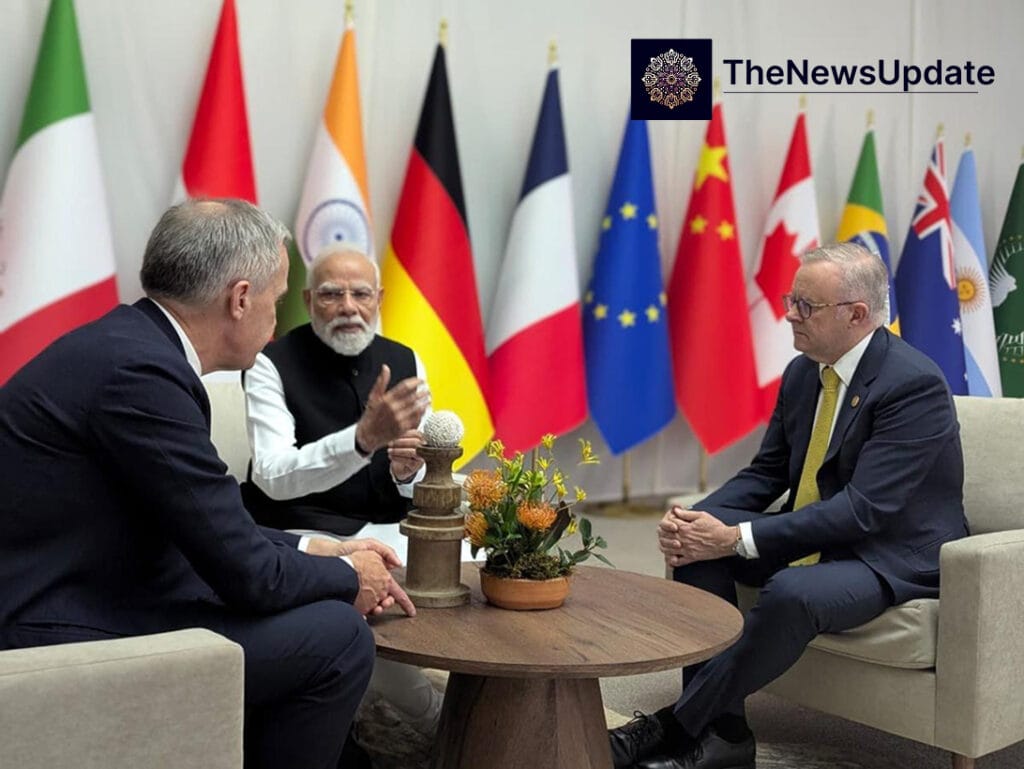
Leaders arrived with varied priorities—ranging from conflict resolution and climate finance to trade reforms and critical mineral partnerships. Prime Minister Narendra Modi reached Johannesburg a day early, holding several bilateral meetings, including with Australian Prime Minister Anthony Albanese. Modi highlighted India’s commitment to addressing global challenges through collective action.
PM Modi’s Six-Point G20 Agenda
One of the most discussed G20 Summit 2025 Key Takeaways was PM Modi’s ambitious six-point proposal. His agenda was not only forward-looking but deeply aligned with India’s rising leadership role on the global stage.
Here are the six core elements of Modi’s agenda:

- 1. G20 Initiative on Countering the Drug-Terror Nexus: Modi stressed the alarming global rise of narcotics-linked terrorism. He urged coordinated action to dismantle trafficking networks supplying funds to extremist groups.
- 2. G20 Global Healthcare Response Team: Inspired by lessons from COVID-19, this team would consist of trained medical professionals mobilized instantly during global health emergencies.
- 3. G20 Africa-Skills Multiplier Initiative: To promote Africa’s workforce transformation, India proposed a multi-country skills and capacity-building program.
- 4. Global Traditional Knowledge Repository: A platform to preserve and use diverse medicinal and ecological knowledge, especially from indigenous communities.
- 5. G20 Open Satellite Data Partnership: A plan to make satellite data accessible for disaster management, agriculture, and climate monitoring.
- 6. G20 Critical Minerals Circularity Initiative: A move to ensure that minerals like lithium, cobalt, and copper are reused sustainably and equitably.
Modi’s proposals reaffirm India’s push for sustainable development, technology-enabled governance, and south-south cooperation. They also positioned India as a key architect of future global frameworks.
Climate Declaration & US Boycott
Perhaps the most dramatic G20 Summit 2025 Key Takeaways revolved around the United States boycott. For the first time in decades, the US did not participate in drafting the G20 declaration.
The White House openly accused South Africa of obstructing a smooth transition of G20 presidency. President Donald Trump ordered a boycott, claiming that South Africa’s internal policies were discriminatory and ideologically biased.

Despite this, the G20 successfully adopted a major climate declaration—an achievement many considered remarkable given the geopolitical tensions. The declaration committed member nations to stronger climate action, sustainable energy transitions, and environmental protection.
The boycott highlighted growing fractures in global governance, but it also showed that other major economies—including India, the EU, Japan, and African nations—were willing to move forward collectively, even without US participation.
Critical Minerals Framework

Another major G20 Summit 2025 Key Takeaways was the adoption of the G20 Critical Minerals Framework. As the world transitions to clean energy, demand for minerals like lithium, nickel, cobalt, rare earth elements, and copper is rising exponentially.
यह भी पढ़े:
 Osman Hadi Killers Fled to India via Meghalaya Border: Dhaka Police Reveal Shocking Escape Route
The framework aims to ensure that mineral-rich nations—mostly in the Global South—benefit fully from their resources. Historically, these countries have faced:
- Underinvestment in mining infrastructure
- Low value addition and refining capacity
- Lack of technology transfer
- Environmental degradation from outdated extraction methods
- Limited participation in global supply chains
The initiative promotes responsible mining, equitable pricing, and fair trade mechanisms. It also encourages investment in local processing industries to prevent resource exploitation.
Scaling Up Climate Finance
The G20 declaration echoed a central theme of COP30: climate finance must scale from billions to trillions. This is one of the most significant G20 Summit 2025 Key Takeaways, especially for developing nations.

The document emphasizes:
- Expanding funding for infrastructure resilience
- More accessible climate financing for African nations
- Greater private investment participation
- Support for vulnerable nations facing extreme weather events
- Creation of modern early warning systems to protect high-risk communities
Leaders acknowledged the funding gap between developed and developing economies, urging wealthier nations to meet their long-delayed climate finance commitments.
Ukraine Conflict on the Sidelines
Although the Ukraine war was mentioned only once in the official declaration, it dominated behind-the-scenes conversations. Western leaders held urgent side meetings after details of US President Trump’s 28-point peace plan leaked.
यह भी पढ़े:
 Bulldozer Raj Karnataka Demolitions: Congress Govt Faces Backlash After 400 Muslims Left Homeless
European leaders responded cautiously, saying the plan needed “additional work,” and pledged close coordination with both Ukraine and the US. The goal was to buy President Zelensky time and form a united counter-proposal.
This subtle but strong emphasis on diplomacy was one of the understated yet major G20 Summit 2025 Key Takeaways. Leaders also reiterated the need for lasting peace in Sudan, the Democratic Republic of Congo, and the Palestinian territories.
Conclusion: What the G20 Summit 2025 Means for the Future
The G20 Summit 2025 Key Takeaways paint a picture of a world undergoing profound realignment. With the US absent from key negotiations, other nations stepped into leadership roles—especially India, South Africa, and the European Union.

Modi’s six-point agenda reinforced India’s growing influence as a global problem-solver. The climate declaration demonstrated that global climate action can proceed even when major powers disagree. Meanwhile, discussions on Ukraine, critical minerals, and climate finance highlighted the pressing need for cooperation in an era of uncertainty.
As the world moves deeper into the decade, the outcomes of the G20 Summit 2025 will shape long-term policies on sustainability, development, conflict resolution, and global governance.
Related Reads
By The Morning News Informer — Updated Nov 23, 2025