Summary
Scientists analysing 15 years of data from NASA’s Fermi Gamma-ray Space Telescope report the discovery of a halo of ~20 GeV gamma rays around the Milky Way’s centre that closely matches theoretical predictions for annihilating WIMP (weakly interacting massive particle) dark matter. The finding—described by lead analyst Professor Tomonori Totani (University of Tokyo)—would represent a major milestone if independently confirmed, because dark matter has resisted direct detection despite dominating the universe’s mass budget. Researchers, however, stress caution: astrophysical sources such as unresolved pulsars, cosmic-ray interactions with galactic gas, or novel backgrounds could mimic the signal. Independent verification and further analysis are essential before the claim can be elevated from intriguing hint to accepted discovery.
What the Fermi data show
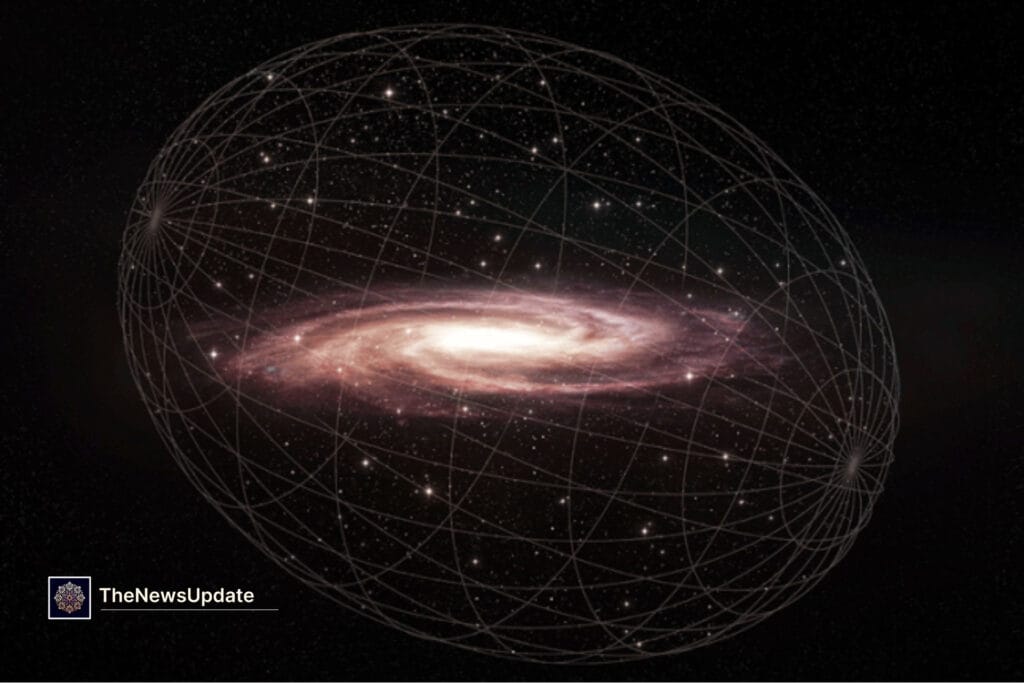
Professor Tomonori Totani’s team reprocessed and analysed 15 years of Fermi-LAT observations focused on the Galactic Centre, the region long known for complex gamma-ray emission. Their analysis isolates a roughly spherical gamma-ray halo peaking at energies near 20 GeV and extending over scales consistent with predictions for a dark matter density profile concentrated around the Galactic Centre.
Key characteristics of the reported halo include:

- Energy peak near ~20 gigaelectronvolts (GeV).
- A spatial distribution that is approximately spherically symmetric around the Galactic Centre and falls off with radius in a manner consistent with several dark-matter halo models.
- Signal morphology that, according to the authors, matches predictions for annihilating WIMP particles with specific mass and annihilation-channel assumptions.
These properties are precisely the features that dark-matter annihilation models predict: dense dark-matter concentrations in the Galactic Centre produce particle-antiparticle annihilations which, depending on the particle physics model, can generate gamma rays in the observed energy band.
Why this would matter
Dark matter is the invisible scaffolding of cosmic structure: it exerts gravitational influence on galaxies, clusters and the cosmic web, but it does not interact electromagnetically, making it invisible to conventional telescopes. The leading particle candidates—WIMPs—would interact only weakly with ordinary matter and, crucially, could annihilate or decay into standard-model particles, including gamma rays. Detecting a gamma-ray signature that matches both the spatial distribution and the energy spectrum predicted for WIMP annihilation would be the first direct evidence linking a particle signal to the dark-matter halo enveloping the Milky Way.
Such a discovery would reshape particle physics and cosmology: it would identify the particle nature of dark matter, constrain its mass and interaction channels, and provide a laboratory for probing physics beyond the Standard Model.

Sources of caution: why the team and the community are careful
Despite the excitement, both the study authors and independent experts emphasize that the result is tentative. There are several reasons for caution:
- Astrophysical confounders: the Galactic Centre is crowded with gamma-ray sources—millisecond pulsars in particular have been proposed as an explanation for previous gamma-ray excesses. Unresolved populations of faint pulsars can collectively mimic a smooth halo when instrument sensitivity is limited or when source-subtraction techniques leave residuals.
- Diffuse emission modelling: cosmic-ray interactions with interstellar gas and radiation fields produce diffuse gamma-ray backgrounds. Slight mismodelling of cosmic-ray propagation or gas distribution can produce residuals that masquerade as a dark-matter-like signal.
- Instrumental systematics: long-duration datasets can hide subtle instrumental effects, calibration drifts, or analysis choices that bias spatial or spectral reconstructions.
- Prior debates: the community has previously flagged a “Galactic Centre gamma-ray excess” in Fermi data, with protracted arguments about whether it originates from dark matter or astrophysical sources. Past controversy urges rigorous independent reanalysis and cross-checks.
Because of these confounders, Totani and colleagues call for independent teams to reanalyse the Fermi data with different pipelines, to evaluate alternative background models, and to test whether the signal persists when known point sources and diffuse templates are varied.
How independent verification could be achieved
Confirming a claimed dark matter signal requires multiple, converging lines of evidence. Some practical next steps include:

- Independent reanalyses: other groups should reprocess Fermi-LAT data with alternative foreground models, point-source catalogs, and event-selection criteria to test signal robustness.
- Multi-instrument comparisons: cross-checks with gamma-ray instruments (for example, ground-based Cherenkov telescopes like the Very Energetic Radiation Imaging Telescope Array System — VERITAS, or the upcoming Cherenkov Telescope Array — CTA) can probe complementary energy ranges and systematics.
- Multiwavelength studies: radio and X-ray observations can help identify populations of millisecond pulsars or other astrophysical sources that might account for the gamma-ray emission.
- Temporal and spectral tests: pulsar populations often show variability, distinct spectral shapes, or point-like clustering; dark matter annihilation should produce a smooth, time-stable and predictable spectrum tied to particle physics models.
- Substructure and morphology tests: dark-matter predictions include scaling of the signal with Galactic radius and potential signals from satellite dwarf galaxies; detecting consistent signals across multiple dark-matter-dominated systems would strengthen the case.
Previous signals and why the community remained uncertain
The Milky Way’s centre has been the site of long-running debates. Since the early 2010s, researchers identified a gamma-ray excess in Fermi data (sometimes dubbed the “Galactic Centre Excess”) that some interpreted as dark matter annihilation. However, subsequent analyses suggested the excess could be explained by unresolved point-source populations — especially millisecond pulsars concentrated in the bulge — or by mismodelling diffuse emission.
Those mixed outcomes taught the field two lessons: (1) robust dark matter claims must survive numerous analysis choices and independent pipelines, and (2) multi-instrument corroboration is essential to distinguish particle signals from complex astrophysical backgrounds.
What the Totani analysis adds
Totani’s work claims improved separation of diffuse backgrounds and a morphological match to canonical dark-matter halo profiles. By leveraging 15 years of data and updated event selections, the team argues the observed halo’s shape and spectral peak are consistent with annihilating WIMPs of a particular mass range. If these assertions hold under independent scrutiny, the finding would sharpen the parameter space for particle physics searches and motivate targeted experiments both in space and underground.
यह भी पढ़े:
 Samsung Bixby Perplexity AI Integration: 7 Key Signs Samsung Is Reinventing Its Voice Assistant
Particle physics implications if confirmed
Should the gamma-ray halo be confirmed as dark matter annihilation, it would deliver immediate constraints on key particle properties:
- Mass range: the energy spectrum around ~20 GeV points toward WIMP masses in a corresponding band, narrowing search windows for direct-detection experiments and collider searches.
- Annihilation channels: the spectral shape can indicate whether dark matter annihilates preferentially into quarks, gauge bosons, or leptons, which informs theoretical model-building.
- Cross-section: the observed flux would let researchers estimate the annihilation cross-section, a central parameter for thermal WIMP scenarios and cosmological abundance calculations.
Direct-detection experiments (which seek dark-matter-nucleus scattering) and collider searches (which seek missing-energy signatures) would use these astrophysical constraints to focus sensitivity and refine search strategies.
Broader scientific reaction
Reaction in the astrophysics community is cautious excitement. Many researchers praised the rigor of the 15-year analysis while underscoring the need for diverse cross-checks. The Fermi-LAT team itself, other gamma-ray groups, and upcoming facilities like CTA are likely to prioritise follow-up analyses. At the same time, groups specialising in pulsar population synthesis and cosmic-ray propagation will intensify efforts to evaluate astrophysical alternatives.

Funding agencies and observational consortia may also see increased interest in deep observations of the Galactic Centre and dwarf satellite galaxies—locations where a genuine dark-matter annihilation signal should also manifest in predictable ways.
Conclusion: an exciting but tentative hint
The report of a gamma-ray halo around the Milky Way’s centre that matches dark-matter annihilation predictions is among the most intriguing astrophysical hints yet. It brings renewed optimism to a field that has endured decades of non-detections. Yet science proceeds by skepticism as much as by discovery: independent verification, cross-instrument confirmation, and exclusion of astrophysical confounders are indispensable.
For now, Totani’s result is best described as a compelling hint—one that sharpens hypotheses, refocuses observational campaigns, and will spark months if not years of intense follow-up. If subsequent analyses corroborate the finding, humanity may be on the threshold of finally seeing the particle nature of the universe’s invisible majority. Until then, researchers will work methodically to separate signal from noise, aware that the stakes—understanding what most of the universe is made of—could not be higher.
यह भी पढ़े:
 New York Times Reporter, Authors Sue Google, OpenAI, Meta Over AI-Based Copyright Infringement
Further reading
Updated 29 November 2025 —The Morning News Informer