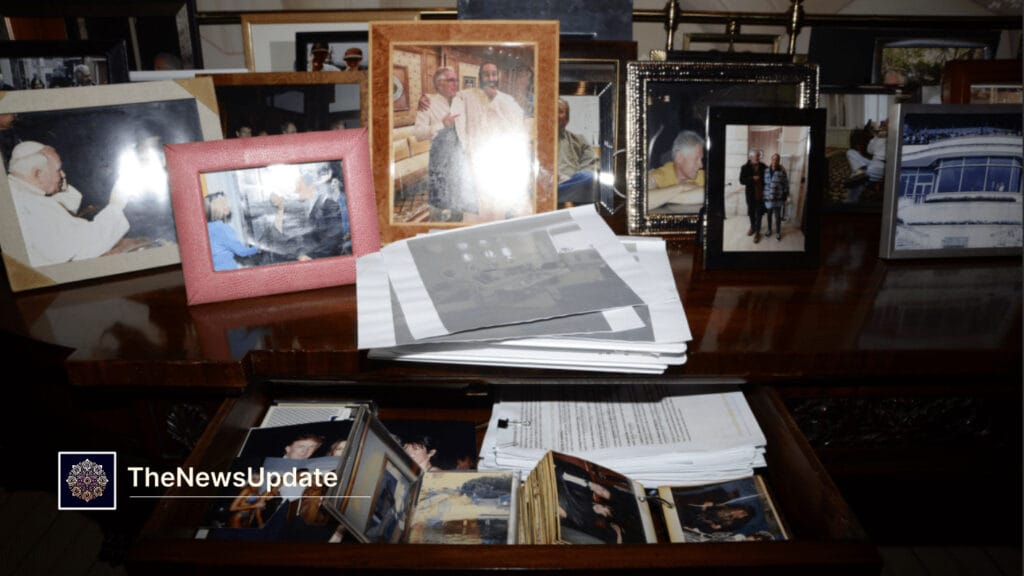
An Epstein files Trump image from the newly released Epstein files that includes former US President Donald Trump was temporarily removed from the US Department of Justice (DOJ) website before being reinstated, triggering political backlash and renewed scrutiny of how the government is handling the long-awaited disclosure of records related to the late financier and convicted sex offender Jeffrey Epstein.
The image was among thousands of documents, photographs, and investigative materials released on Friday under a congressional mandate requiring the DOJ to make public its Epstein-related files. The temporary disappearance of the image, followed by its quiet reappearance, quickly became a flashpoint in an already charged debate over transparency, victims’ rights, and political accountability.
Deputy Attorney General Todd Blanche confirmed on Sunday that the image was removed out of caution after concerns were raised by victims’ advocacy groups. He said it was later reinstated following a review that found no evidence that any of Epstein’s victims were depicted in the photograph.

Why the Image Was Removed From the DOJ Website Epstein files Trump image
The DOJ said the image was flagged by the Southern District of New York, which handled Epstein’s prosecution, for potential further action to protect victims. Officials explained that the photograph contained multiple unredacted images of women, prompting concerns that one or more could be Epstein victims whose identities should not be publicly disclosed.
In a statement posted on X, the justice department said the image was removed temporarily “out of an abundance of caution” while officials conducted a review. After that review, the department concluded that there was no evidence linking any of the women in the image to Epstein’s victims.
“After the review, it was determined there is no evidence that any Epstein victims are depicted in the photograph, and it has been reposted without any alteration or redaction,” the DOJ said, linking directly to the reinstated image.

Officials stressed that the removal was not unusual, noting that several other photographs were also taken down briefly after concerns were raised by victims’ rights groups.
What the Image Shows
The photograph was taken inside one of Epstein’s residences and shows a cabinet or desk topped with a collection of framed photographs, many featuring well-known public figures. The image also reveals an open drawer containing additional photos.
One of the framed pictures visible in the image includes Donald Trump. Another photograph inside the drawer reportedly shows Trump alongside Epstein, then–First Lady Melania Trump, and Epstein’s longtime associate Ghislaine Maxwell, who has since been convicted on sex trafficking-related charges.

US officials have said the image offers context about Epstein’s social circles but does not, on its own, indicate criminal conduct by any of the individuals pictured.
Claims of Political Interference Rejected
The brief removal of the image sparked immediate speculation online and among Democratic lawmakers that the DOJ may have acted to shield the sitting US president from embarrassment.
Blanche rejected those claims outright, calling the suggestion “laughable.” In an interview with NBC News, he said the image had nothing to do with Donald Trump personally and everything to do with compliance with court-ordered obligations to consider victims’ concerns.

“There are dozens of photos of President Trump already released to the public seeing him with Mr Epstein,” Blanche said. “So the absurdity of us pulling down a photo, a single photo, because President Trump was in it, is laughable.”
He added that if the department intended to hide Trump’s past association with Epstein, it would not have released any of the other publicly available images showing the two men together.
Democrats Question DOJ Transparency
Despite the DOJ’s explanation, Democrats on the House Oversight Committee voiced skepticism. In a post on social media, committee members publicly questioned Attorney General Pam Bondi, asking, “What else is being covered up?”

The lawmakers said the unexplained removal of files undermines public trust and raises concerns about whether the DOJ is fully complying with the law requiring the release of Epstein-related records.
The controversy intensified after reports emerged that at least 13 files had disappeared from the DOJ website by Saturday, a day after the initial release. The department did not immediately provide a detailed explanation for each missing file.
The Law Mandating the Epstein Files Release
The release of the Epstein files follows the passage of a law by Congress mandating that the DOJ make public its records related to Epstein by Friday. The move was widely supported by lawmakers from both parties who argued that transparency was long overdue.

The documents were highly anticipated by victims, journalists, and the public, many of whom hoped the files would shed new light on Epstein’s crimes, his associates, and any institutional failures that allowed his abuse to continue for years.
However, the DOJ had already faced criticism even before the image controversy for failing to release all of the files by the deadline.
Victims’ Rights and Judicial Oversight
Blanche said the department’s actions were guided by a judge’s order in New York requiring prosecutors to take seriously any concerns raised by Epstein’s victims or advocacy groups representing them.

“A judge has ordered us to listen to any victim or victims’ rights group if they have concerns,” Blanche said, explaining why multiple images were pulled down for review after their initial release.

Victims’ advocates have long argued that the public release of Epstein-related materials must balance transparency with the need to protect survivors from further harm or unwanted exposure.
Trump’s Relationship With Epstein
Donald Trump has consistently denied any wrongdoing in relation to Jeffrey Epstein. He has not been accused of any crimes by Epstein’s victims, and US authorities have said there is no suggestion that the images released imply illegal conduct by him.

Trump has previously acknowledged knowing Epstein socially, as did many wealthy and powerful figures in the 1990s and early 2000s. He has also said that he cut ties with Epstein years before the financier’s first arrest.
US officials have reiterated that appearing in photographs with Epstein does not equate to involvement in his crimes.
What Else Is in the Epstein Files
The latest document release includes thousands of pages of material, such as photographs, videos, witness statements, and investigative records connected to Epstein’s activities and prosecution.

Ten of the files that were temporarily removed reportedly contain images of the same room inside one of Epstein’s homes. The room appears to be a small massage parlour with clouds painted on the ceiling and brown patterned wallpaper covered with images of nude women.
Some of the images appear to be photographs, while others are artworks. In many cases, the faces of the women depicted have been redacted to protect identities.
However, inconsistencies have drawn attention. In one file, a face is redacted, while the same face appears clearly visible in several other files. Another individual’s face remains unredacted across multiple documents, while a painted image of the same person is also visible.

Redactions and Missing Information
The DOJ has said it redacted materials to comply with legal and ethical obligations. These include personally identifiable information about victims, materials depicting child sexual abuse, records showing physical abuse, and documents that could jeopardise active federal investigations.
Classified documents related to national defence or foreign policy were also withheld, according to the department.
As a result, many of the released documents are heavily redacted, limiting their usefulness to researchers and journalists.

Limited New Revelations So Far
Despite the scale of the release, there has been little new information about Epstein’s crimes. Key materials, such as internal DOJ memoranda explaining charging decisions or prosecutorial strategy, were not included.
This has disappointed many who hoped the files would provide clearer answers about how Epstein was able to evade accountability for so long and whether powerful individuals received preferential treatment.
Growing Frustration in Congress
Republican Congressman Thomas Massie of Kentucky, who helped lead the push to force the release of the Epstein files, said he is deeply frustrated with how the DOJ has handled the disclosure.

Massie said his focus remains on justice for Epstein’s victims rather than political point-scoring. He accused the department of failing to comply with both the spirit and letter of the law.
“They are flouting the spirit and the letter of the law,” Massie told CBS News. “It’s very troubling the posture that they have taken. I won’t be satisfied until the survivors are satisfied.”
Massie said he is drafting inherent contempt charges against Attorney General Pam Bondi, a rare and serious step that would escalate the dispute between Congress and the justice department.

Public Trust and Ongoing Scrutiny
The controversy surrounding the reinstated image underscores the challenges facing the DOJ as it navigates demands for transparency while attempting to protect victims and comply with court orders.
For critics, the episode reinforces concerns that the Epstein case continues to be handled in a way that leaves too many questions unanswered. For the department, it highlights the difficulty of releasing sensitive materials in a highly politicised environment.
As lawmakers, journalists, and advocacy groups continue to examine the released files, scrutiny of the DOJ’s actions is unlikely to fade.

What Happens Next
The DOJ has said it will continue to review the Epstein files and respond to concerns raised by victims or the courts. Additional documents may be released, removed, or redacted as legal reviews continue.
Meanwhile, congressional pressure is expected to intensify, with lawmakers demanding fuller disclosure and clearer explanations for missing or altered files.
The reinstated image featuring Donald Trump has become a symbol of the broader debate over transparency, accountability, and justice in one of the most notorious criminal cases in recent US history.

Other Reads
By Ana Faguy — Updated December 22, 2025