Table of Contents
- Quick summary
- What was approved — the numbers and milestones
- Why the Elon Musk Tesla pay deal matters
- Legal and governance context
- Investor and market reactions
- What’s next for Tesla, Musk and xAI
- Verdict — risks, rewards and red flags
- Related reads
Quick summary
Tesla shareholders approved a record-breaking, performance-based compensation plan for Elon Musk that could be worth up to $1 trillion in stock if the company meets extremely ambitious targets over the next decade. The package—reported variously as up to $878 billion in grant value before valuation effects or loosely described as a potential $1 trillion payday—received more than 75% shareholder support at Tesla’s annual meeting in Austin, Texas. The vote also included board changes and cleared the way for potential investment ties between Tesla and Musk’s AI startup, xAI.
What was approved — the numbers and milestones
The core mechanics of the Elon Musk Tesla pay deal are performance tranches tied to stretch targets. If all milestones are met over the coming years, Musk stands to receive massive stock grants that proponents say align his pay with company performance; critics call them extraordinary and risky.
Key headline elements:

- Potential maximum value: widely reported as up to $1 trillion in headlines, while company documents and coverage specify up to about $878 billion in stock units before valuation swings and deductions.
- Approval level: more than 75% of shareholders voted in favour at the Austin meeting.
- Targets include: very large production and revenue milestones — e.g., multi-million vehicle annual outputs, deployment of large robotaxi fleets, sales of humanoid robots, and a dramatic increase in market capitalisation (targets referenced in filings).
- Other votes: shareholders approved board re-elections and a proposal that allows Tesla to invest in Musk’s xAI venture, subject to additional approvals and abstentions.
Why the Elon Musk Tesla pay deal matters
At a basic level, the deal signals shareholder confidence in Musk’s long-term strategy: pivoting Tesla from an electric vehicle maker toward a broader AI and robotics platform. Practically, it binds Musk’s compensation to performance indicators that would, if achieved, transform Tesla’s business model and revenue streams (robotaxis, humanoid robotics, advanced AI services).
Strategic implications include:
- Board leverage and control: A strong shareholder vote gives the board and Musk political room to pursue bold, capital-intensive projects without immediate activist pushback.
- Talent and investment magnet: Ambitious targets tied to stock upside can help attract engineering talent and outside investment into AI and robotics initiatives linked to Tesla and xAI.
- Market expectations: The milestones effectively set a roadmap for what the market must expect from Tesla over the next decade — and the company will be judged against those public benchmarks.
Legal and governance context
This vote did not happen in a vacuum. Musk’s previous compensation package (the widely cited 2018 award) was invalidated in court, and Tesla has since faced governance scrutiny over executive pay, board independence, and relocation of corporate governance to Texas. The new proposal was resubmitted after legal and procedural obstacles and framed by the board as a choice between approving the plan or risking senior leadership disruption.

That legal backdrop is important because it shapes shareholder calculus: some institutional investors opposed the plan on dilution and governance principles, while others worried that rejecting it could prompt Musk to reduce his focus on Tesla or even depart—an outcome perceived as potentially destructive to shareholder value.
Investor and market reactions
The vote produced mixed reactions across the market. Short-term market moves were muted to modestly positive as investors digested the long-term implications and the sheer scale of the targets. Several large institutional investors publicly questioned the package’s size and governance safeguards, while many retail shareholders and insider-heavy voting blocs backed the measure.
Investor groups who opposed cited concerns about:
- Share dilution — massive stock grants would dilute existing holders if fully earned.
- Governance norms — critics said this deviates from typical executive-pay practices in favour of superstar founder incentives.
- Execution risk — the milestones are extraordinarily challenging and depend on near-flawless execution across hardware, software, and regulatory fronts.
What’s next for Tesla, Musk and xAI
With the Elon Musk Tesla pay deal approved, the next phase is operational: Tesla must demonstrate progress on the milestones that underpin gravy-train payouts. Watch for these tangible short-to-medium term markers:
- Quarterly disclosures and product timelines that show scaling of Optimus humanoid production and robotaxi deployment plans.
- Announcements of strategic investments or partnerships — including any formal tie-ups with xAI to develop neural networks, real-world data systems, or compute infrastructure.
- Capital allocation moves: whether Tesla ramps up R&D capital spending, builds new fabs or chip facilities, or shifts cash toward robotics lines.
- Regulatory and safety milestones: approvals and safety validation for autonomous vehicle programs will be critical for unlocking value tied to robotaxis.
Verdict — risks, rewards and red flags
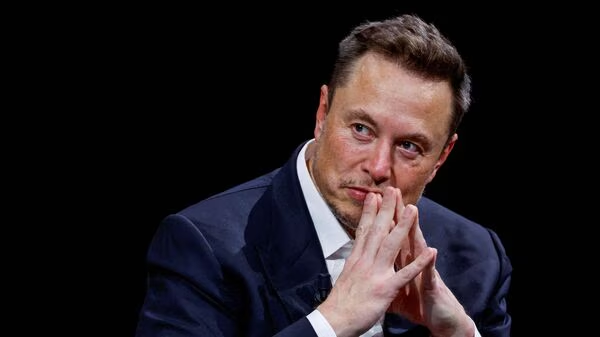
The Elon Musk Tesla pay deal is at once a bold alignment device and a governance lightning rod. On the reward side, if Tesla truly becomes an AI and robotics leader with new, recurring revenue streams, shareholders who granted huge upside could be richly rewarded. On the risk side, the plan concentrates enormous power in one individual and sets targets that many industry observers consider highly optimistic.
Practical red flags to monitor:
यह भी पढ़े:
 Samsung Bixby Perplexity AI Integration: 7 Key Signs Samsung Is Reinventing Its Voice Assistant
- Execution feasibility: Building millions of robotaxis and humanoid robots requires not just R&D but manufacturing scale, regulatory approval, and mass-market demand.
- Valuation assumptions: Much of the headline $1 trillion figure depends on market-cap growth assumptions that could never materialize.
- Reputational risk: Political statements or controversial behavior by the CEO can still impact brand strength and sales — a factor shareholders will judge over time.
Related reads
By The Morning News Informer — Updated November 7, 2025