Bihar RJD leader Bangladesh protest remark
On the eve of Bihar’s election results, Rashtriya Janata Dal (RJD) leader Sunil Kumar Singh has stirred controversy by warning officials of potential unrest if the counting process is tampered with. His remarks, comparing possible protests in Bihar to those in Bangladesh, Nepal, and Sri Lanka, have drawn sharp criticism and triggered a political storm ahead of the state’s crucial verdict day.
As Bihar braces for election results, the state is witnessing rising tension between the ruling National Democratic Alliance (NDA) and the opposition Mahagathbandhan. Singh’s remarks come at a sensitive juncture, with exit polls predicting a potential majority for the NDA while RJD leaders claim confidence in forming the next government under Tejashwi Yadav.
यह भी पढ़े:
 Osman Hadi Killers Fled to India via Meghalaya Border: Dhaka Police Reveal Shocking Escape Route
RJD Leader’s Controversial Remarks Raise Political Temperature Bihar RJD leader Bangladesh protest remark
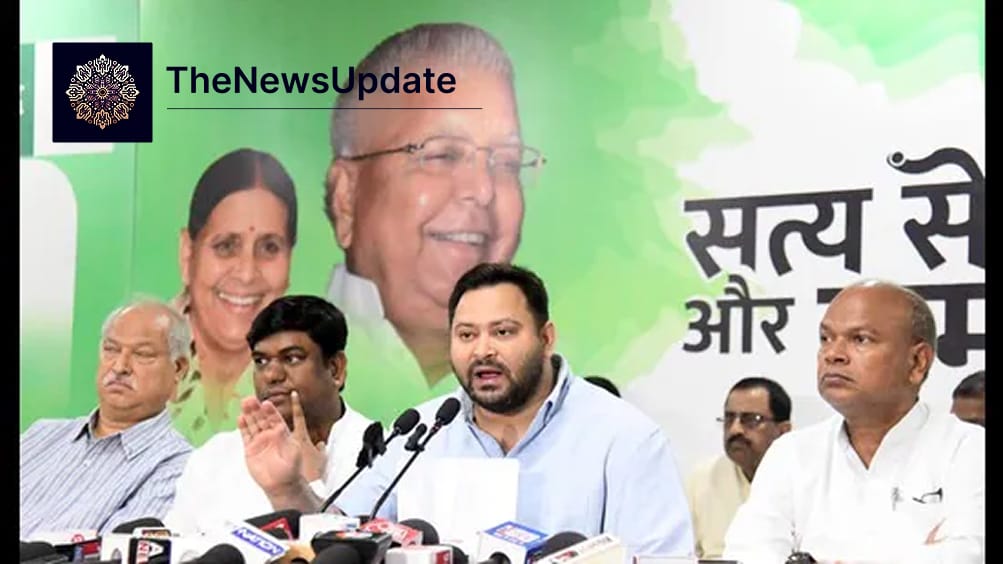
Speaking at a gathering of RJD officials and polling agents, Sunil Kumar Singh issued a caution to those involved in the vote counting process. He warned against manipulating the people’s mandate and suggested that any interference could provoke public outrage similar to what was seen in regional uprisings across South Asia.
“Many of our candidates were forcibly defeated in 2020. I have requested all officials involved in the counting process that, if you defeat the person whom the public has given their mandate, the same scenes you witnessed on the roads in Nepal, Bangladesh, and Sri Lanka will be seen on the roads of Bihar as well,” Singh declared.
His statement, perceived as an indirect warning of potential unrest, sparked immediate backlash from political opponents and civil society groups. While the RJD maintains that Singh’s comments were a “warning against manipulation,” the Election Commission of India (ECI) took note of the statement, and an FIR was registered against him for making an “inflammatory” remark.
यह भी पढ़े:
 Bulldozer Raj Karnataka Demolitions: Congress Govt Faces Backlash After 400 Muslims Left Homeless
RJD’s Position and Defence
Reacting to the controversy, Singh remained unapologetic. “Even if a hundred FIRs are filed, we will still speak the truth,” he said. He reiterated that the RJD is vigilant against any attempts to subvert the people’s verdict and claimed that his party expects to secure between 140 and 160 seats in the 243-member Bihar assembly.
According to Singh, the RJD’s internal assessments and feedback from the ground indicate a “clear public mood for change.” He asserted that Tejashwi Yadav would be the “next Chief Minister of Bihar,” dismissing the exit polls that predicted an NDA majority.
Exit Polls Predict NDA Majority, But RJD Claims Confidence
As counting day approaches, most exit polls point to an advantage for the ruling National Democratic Alliance (NDA), led by Chief Minister Nitish Kumar and supported by the Bharatiya Janata Party (BJP). The Axis My India exit poll projects the NDA to win between 121 and 140 seats, while the Mahagathbandhan alliance — comprising the RJD, Congress, and Left parties — is expected to win between 98 and 118 seats.

According to these projections, the NDA’s vote share has risen from 37% in 2020 to 43% in 2025, while the opposition bloc’s share stands at around 41%. Despite the narrow gap, RJD leaders argue that exit polls have been unreliable in past Bihar elections and that ground realities favor them this time.
Political observers believe that Singh’s statement reflects the anxiety within opposition ranks ahead of counting day. However, they warn that invoking comparisons to unrest in neighboring countries may deepen divisions and harm Bihar’s image as a stable democracy.
Historical Context: Political Volatility in Bihar
Bihar has long been a politically charged state, with volatile electoral shifts and deeply rooted caste dynamics shaping its outcomes. Over the decades, it has seen multiple phases of coalition governments, defections, and ideological realignments.
Experts note that statements like Singh’s echo Bihar’s history of mass political mobilization and street protests, especially during times of disputed elections or alleged administrative bias. However, comparing local unrest to the large-scale movements seen in Bangladesh or Sri Lanka — where political and economic crises led to mass upheavals — may be both exaggerated and dangerous.
Political analyst Ajay Kumar commented, “Drawing parallels with Bangladesh or Sri Lanka is not just unnecessary, it can be inflammatory. Bihar’s democracy has evolved significantly, and institutions here are stronger. Political leaders must exercise restraint while making such remarks during sensitive periods.”
Election Commission and Law Enforcement Response
Following Singh’s comments, the Election Commission of India directed the Bihar Chief Electoral Officer to submit a report on the incident. Law enforcement agencies swiftly filed an FIR under sections related to incitement and public disorder.
यह भी पढ़े:
 Canada Hospital Killed Indian-Origin Man: Wife Alleges Medical Negligence After 8-Hour Wait
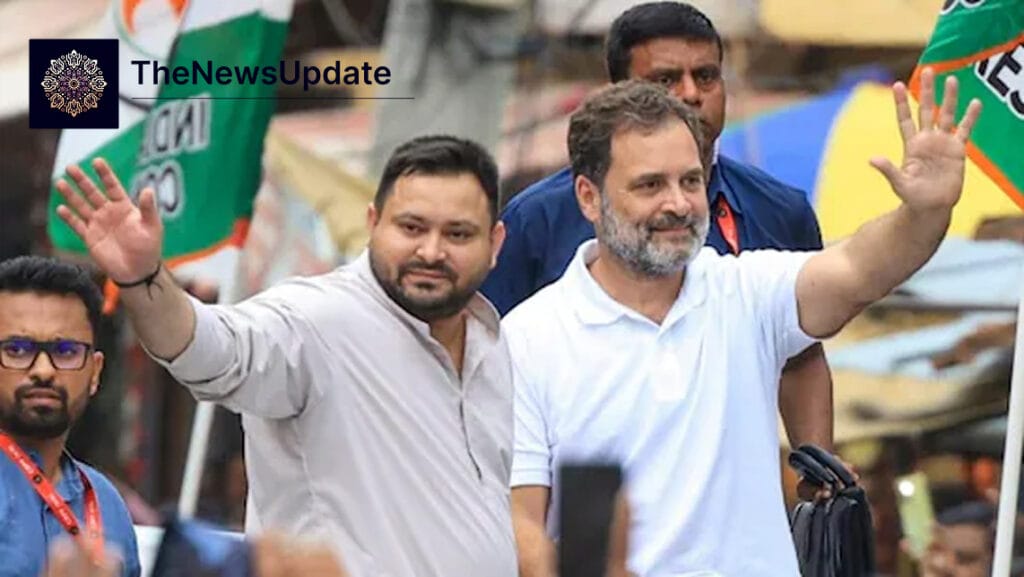
Senior police officials confirmed that the statement was being investigated for potential violation of the Model Code of Conduct and for causing unrest during the election process. Meanwhile, RJD spokespersons have defended Singh, claiming his remarks were a “warning against possible irregularities, not a threat.”
“We believe in democracy and peaceful elections. The statement was only a reminder that the public will not tolerate manipulation of votes,” said RJD spokesperson Mrityunjay Tiwari.
Tejashwi Yadav’s Reaction and RJD’s Strategy
While Tejashwi Yadav himself refrained from directly commenting on the controversy, party insiders say he has instructed leaders to “focus on counting day preparedness” and not get distracted by political noise.
RJD insiders revealed that the party has deployed legal teams and observers at all major counting centers across Bihar to monitor the process closely. They claim the move is meant to ensure transparency and counter any alleged irregularities during the tallying of votes.
“We will not allow 2020 to repeat,” an RJD source said, referring to the previous election, where the party alleged manipulation in marginal seats despite emerging as the single largest party.
Public Sentiment and Media Response
The remarks by Singh have divided public opinion. While RJD supporters hailed him as a “voice of accountability,” others criticized him for “fear-mongering” and undermining electoral integrity. Social media platforms like X (formerly Twitter) and Facebook witnessed heated debates under hashtags such as #BiharResults2025 and #RJDLeaderControversy.

Several journalists and political commentators emphasized the need for restraint during high-stakes elections. The Times of India editorial described the remarks as “unfortunate,” noting that “election disputes must be addressed through institutions, not insinuations of unrest.”
However, some analysts argued that Singh’s comments reflect the growing frustration among opposition ranks, who believe administrative bias could impact the final tally.
Comparisons with Other South Asian Movements
By referencing Bangladesh, Nepal, and Sri Lanka, Singh evoked examples of public uprisings against corruption, inflation, and authoritarianism. In Bangladesh, large-scale protests erupted in 2022–23 over fuel price hikes and governance issues; in Sri Lanka, citizens took to the streets in 2022, leading to the resignation of President Gotabaya Rajapaksa. Nepal has also witnessed major protests against political instability.
Experts, however, caution that India’s institutional democracy and electoral mechanisms differ vastly from those nations. “Bihar’s political space allows dissent through democratic channels. Drawing parallels to mass revolts in neighboring countries is misleading,” said Professor N. S. Rathore of Patna University.
BJP and NDA’s Reaction: ‘RJD Resorting to Intimidation’
The ruling NDA leaders strongly condemned Singh’s remarks. BJP spokesperson Prem Ranjan Patel said, “This is nothing but an attempt to intimidate officials and influence the counting process. Such statements show RJD’s desperation and lack of confidence.”
JD(U) leaders, meanwhile, urged the Election Commission to take strict action against “irresponsible political rhetoric.” They claimed that the NDA would win “comfortably,” crediting Nitish Kumar’s governance and alliance stability.

“The RJD knows it is losing, which is why they are trying to delegitimize the process even before the results are declared,” said BJP leader Sanjay Jaiswal.
Ground Situation: High Security Ahead of Counting Day
Authorities in Bihar have deployed additional security forces at all counting centers to ensure law and order. The Home Department has instructed district administrations to maintain vigilance and prevent gatherings near counting centers to avoid potential flare-ups.
According to reports, over 60,000 personnel from the Central Armed Police Forces (CAPF) have been stationed across the state, especially in sensitive districts like Patna, Gaya, and Muzaffarpur. The Election Commission has also directed continuous CCTV surveillance during the counting process.

“We are committed to ensuring a peaceful and transparent counting process. Any attempt to disrupt public order will be dealt with strictly,” said a senior official from the Bihar Police.
Broader Implications for Indian Democracy
The controversy underscores a growing trend of charged rhetoric in Indian elections, where leaders often issue warnings about unrest or manipulation. Political experts argue that such statements erode public trust in democratic institutions.
“Elections in India are generally well-conducted and transparent. When senior leaders make provocative remarks, it creates unnecessary fear among citizens,” said political scientist Renu Sharma.

At the same time, analysts highlight that Singh’s comments have succeeded in drawing attention to the need for transparency and fairness in the vote-counting process—an issue that has historically plagued Bihar politics.
Looking Ahead: Bihar’s Political Future
As counting day unfolds, Bihar’s political destiny once again hangs in balance. Whether Singh’s dire warnings materialize or the process remains peaceful, the outcome will shape the state’s governance and leadership for years to come.
Regardless of who forms the government, the controversy surrounding Singh’s remarks highlights one undeniable truth — Bihar’s elections remain a litmus test for India’s democratic resilience.
For more updates on the Bihar election results 2025 and post-result analysis, stay tuned to The News update.