Table of Contents
- Introduction — why pre-training matters
- How the AI predicts human gait
- Real-world results: performance & benefits
- Practical applications: rehab, prosthetics, industry
- Challenges, safety & ethical considerations
- What’s next: commercialization & research directions
- References & further reading
Introduction — why pre-training matters
The arrival of AI pre-trained exoskeleton control marks a turning point for wearable robotics. Traditionally, building an exoskeleton controller meant long cycles of lab-based data collection, user-specific calibration, and repeated retraining — steps that slow prototyping, increase costs, and limit accessibility. Georgia Tech researchers have proposed a different approach: use large sets of existing human motion data to pre-train controllers so devices begin life with a working “brain” that already understands typical gait patterns.
This article explains how the model predicts human gait, the real-world performance gains observed in tests, where this technology matters most, and the technical and ethical hurdles ahead. The focus keyword — AI Pre-Trained Exoskeleton Control — appears throughout because it captures both the technique (pre-training) and the application (exoskeleton control).

How the AI predicts human gait
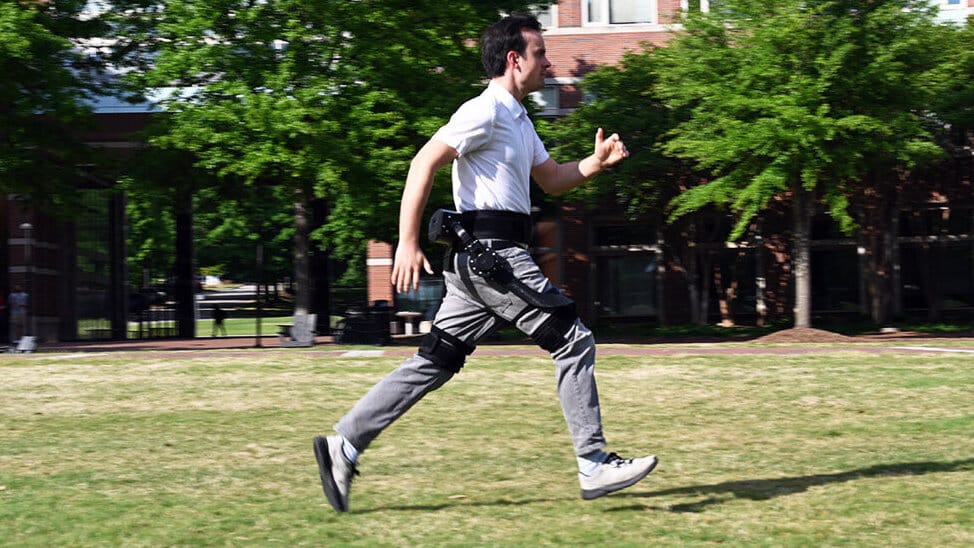
The research adapts deep learning techniques originally developed for other domains to model how humans walk. Rather than training a controller from scratch for each new prototype and user, the team feeds the AI large-scale human motion datasets: recordings of joint angles, forces, accelerations and typical locomotion patterns collected in previous studies. Using these data, the model learns to predict how hip and knee sensors should behave if a person wore an exoskeleton, and how much robotic assistance would be optimal at each moment.
Technically, the model converts raw gait sequences into a mapping between observed human motion and recommended exoskeleton outputs. A key innovation is that the AI predicts both sensor readings and the assistance profile, so the controller doesn’t just imitate movement — it anticipates the moments when torque or support is necessary to reduce wearer effort.
The approach short-circuits the heavy experimental loop. Instead of tens of hours of iterative training with each user, the pre-trained controller arrives with a prior that generalises well to new users and device designs, and requires only light user-specific fine-tuning.

Real-world results: performance & benefits
In trials with a leg exoskeleton, the pre-trained controller tracked joint movements closely and produced meaningful assistance: researchers reported user effort improvements of up to roughly 20% compared with baseline controllers that had not been pre-trained. That gain translates to less muscular exertion, lower fatigue, and a smoother human–machine interaction.
Here are the main benefits observed:
- Faster prototyping: startups can iterate multiple hardware designs without collecting new datasets every time.
- Reduced lab time: fewer lab sessions lower costs and speed regulatory testing.
- Broader applicability: pre-trained models generalise across varied walking speeds and typical gait styles.
- Improved assistance: better anticipation of user motion yields measurable decreases in physical effort.
Importantly, these improvements were achieved while matching the performance of lab-tuned controllers — a notable result because it demonstrates that prior data can substitute for, and sometimes outperform, lengthy per-device retraining.

Practical applications: rehab, prosthetics, industry
The implications of AI Pre-Trained Exoskeleton Control span several sectors:
Rehabilitation & Assistive Mobility
Stroke survivors, people with neurological injuries, and the elderly can benefit from exoskeletons that are ready to assist out of the box. By shortening the clinician-led calibration phase, rehab programs can deploy devices earlier in recovery and personalise support with light adjustments rather than full retraining.
Prosthetics
Pre-trained controllers could power prosthetic limbs that adapt faster to individual walking patterns, improving comfort and functionality for users who otherwise face long tuning periods.
यह भी पढ़े:
 Samsung Bixby Perplexity AI Integration: 7 Key Signs Samsung Is Reinventing Its Voice Assistant
Industrial Exosuits
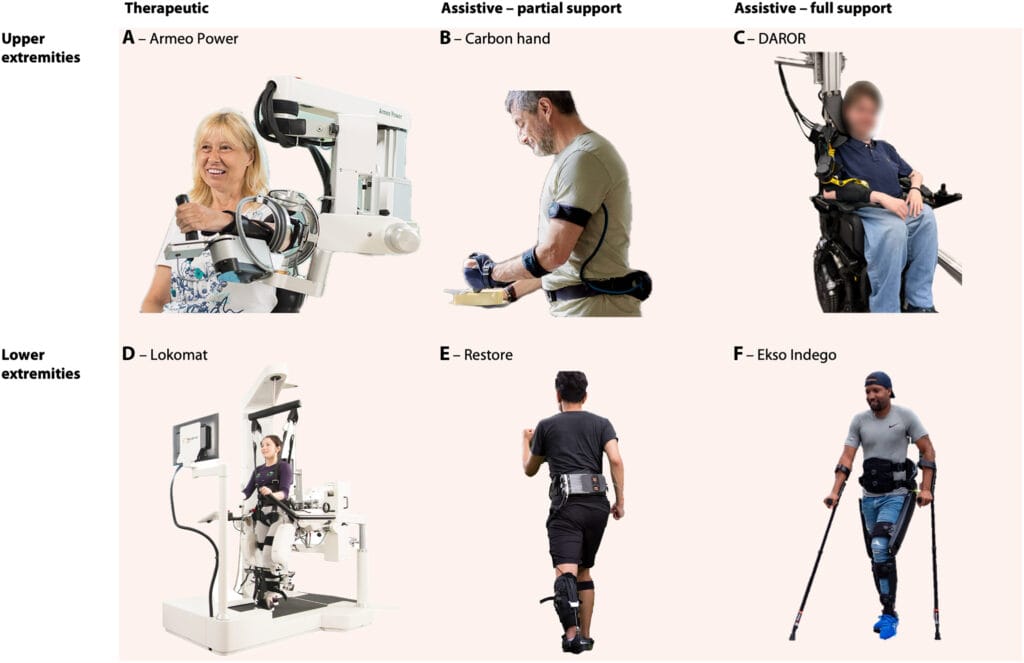
In industry, wearable exosuits aim to reduce fatigue for workers who lift, carry or perform repetitive tasks. Pre-trained assistance models let employers trial and deploy exosuits faster, with less downtime and smaller safety margins during initial rollout.
Consumer & Everyday Mobility
As components get cheaper and controllers more robust, consumer-focused mobility aids may reach a broader market — from recreational support to personal mobility augmentation for outdoor activities.
Challenges, safety & ethical considerations
Despite the clear upsides, the approach raises engineering, regulatory and ethical questions that must be addressed before broad adoption:

1. Generalisation vs. Individualisation
Pre-trained controllers rely on priors learned from aggregated populations. But human gait is highly individual: injury history, limb asymmetry, and neurological conditions all influence movement. Developers must ensure the model safely adapts to edge cases and does not assume a “one-size-fits-most” posture that could harm users.
2. Safety and Certification
Mobility devices interact directly with human bodies. Regulatory bodies will require rigorous validation, fail-safe measures, and transparent performance specifications. Pre-training cannot replace the need for clinical trials and safety testing; it only reduces time to those tests.
3. Data Bias & Representation
If the training datasets are not diverse — excluding older adults, different body types, or varied gait pathologies — the pre-trained model may underperform for excluded populations. Collectors of motion datasets should prioritise inclusivity and proper consent.
यह भी पढ़े:
 New York Times Reporter, Authors Sue Google, OpenAI, Meta Over AI-Based Copyright Infringement
4. Privacy & Data Use
Human motion data can be sensitive. Policies must define who owns gait records, how they’re shared, and how anonymisation is enforced. Consent models and secure storage are non-negotiable.
5. Human-in-the-loop and clinician oversight
Pre-trained controllers should be designed with clinician oversight and easy overrides. Human-in-the-loop approaches (continuous monitoring and quick manual adjustment) will be central to safe clinical use.
What’s next: commercialization & research directions
The next stage is clear: move from lab demos to robust field studies, industry partnerships and regulatory pathways. The research suggests several concrete next steps:

- Broader multi-centre trials with diverse participants
- Open benchmarks for pre-trained controller performance against lab-tuned baselines
- Deployment trials in rehabilitation clinics and factories
- Tooling for fast fine-tuning on-device, preserving privacy
- Standards for dataset curation, consent, and bias reporting
Venture teams and hardware startups stand to benefit from the prototype-speed gains. In parallel, clinicians and advocacy groups must guide equitable deployment to ensure these tools help — not harm — vulnerable populations.
For more on this research and related developments, see:
Conclusion
AI Pre-Trained Exoskeleton Control recasts how we build and deploy mobility-assist wearables. By learning from existing human motion data, controllers can arrive at the clinic or factory already primed to assist — cutting development time, lowering costs, and expanding who can access these life-changing devices.
यह भी पढ़े:
 Indie Band Claims AI Stole Their Billie Eilish Cover, Raising Fresh Fears Over Music Copyright
The road ahead requires careful engineering, broad testing, robust privacy protections, and ethical oversight. But if those guardrails are built, AI-driven pre-training could accelerate a new generation of exoskeletons and prosthetics — devices that move from science fiction to everyday support.
By The Update News — Updated Nov 22, 2025