Table of Contents
- Background: AI and Copyright Challenges
- DPIIT Recommendations for Royalties
- Blanket Licence Model Explained
- Centralised Royalty Collection and CRCAT
- Retroactive Royalties for Past AI Use
- Stakeholder Consultation and Next Steps
- Impact on AI Ecosystem and Creators
Background: AI and Copyright Challenges
The rapid expansion of generative AI Copyright Royalties has raised significant copyright concerns worldwide. AI models developed by companies such as Google, OpenAI, and Anthropic often require large datasets, including copyrighted works like books, images, music, and videos, to train their systems. While these datasets enable AI innovation, they have also sparked debates about fair compensation for creators whose works are being used without direct payment.
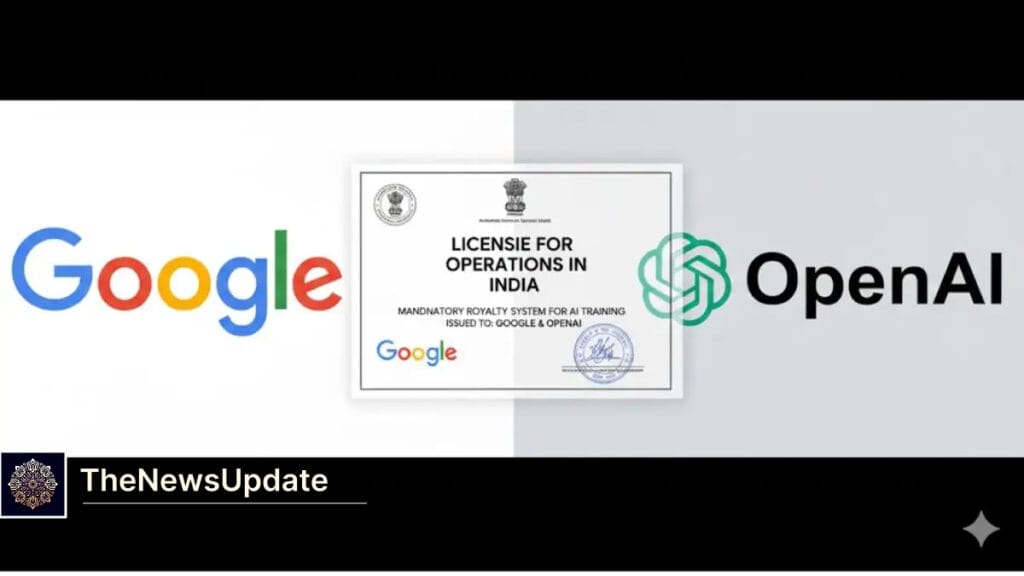
In India, the Department of Promotion of Industry and Internal Trade (DPIIT) under the Ministry of Commerce & Industry has taken a proactive step to address this issue. The government body published a 125-page working paper titled “One Nation One Licence One Payment: Balancing AI Innovation and Copyright,” recommending a structured system for royalties to protect rightsholders while supporting AI development.
DPIIT Recommendations for Royalties
DPIIT’s core recommendation is a blanket licence model for all AI companies using copyrighted content for training commercial AI models. The aim is to:
- Eliminate the need for individual negotiations with rightsholders
- Protect creators’ incentives and creative outputs
- Provide legal clarity and reduce ambiguity around AI training datasets
The working paper highlights that unrestricted use of copyrighted content without compensation could undermine the creative ecosystem, affecting authors, artists, journalists, and other content creators. The committee’s recommendations focus on balancing AI innovation with intellectual property rights AI Copyright Royalties.
Blanket Licence Model Explained
Under the blanket licence system, AI developers would be allowed to use lawfully accessed copyrighted works to train their models without negotiating individually with each content owner. Key aspects include:

- Flat royalty payments to rightsholders for AI model training
- Payments triggered only when the AI model is commercialised
- Exclusion of the need for individual agreements for every copyrighted work
This hybrid approach ensures that creators are fairly compensated while AI companies gain streamlined access to data for model development.
Centralised Royalty Collection and CRCAT
DPIIT proposes the creation of a centralised body called Copyright Royalties Collective for AI Training (CRCAT) to manage royalty collection and distribution. CRCAT would:
- Collect royalties from AI companies
- Disburse payments to rightsholders, including creators not part of formal collective-management organisations (CMOs)
- Standardise royalty rates through a government-appointed committee
This centralised system aims to simplify the royalty process, ensure fair payment, and make the licensing mechanism transparent and efficient for both AI developers and content creators.
Retroactive Royalties for Past AI Use
The DPIIT draft also recommends that royalties should be retroactive. Companies that have already used copyrighted Indian works for commercial AI training would be liable for payment. This ensures fairness and consistency in compensating rightsholders who contributed to datasets used in past AI model developments.
Stakeholder Consultation and Next Steps
DPIIT has opened the draft for public consultation, inviting feedback from stakeholders over the next 30 days. This includes AI companies, creators, industry experts, and legal professionals. The consultation process aims to refine the proposal and address concerns related to implementation, royalty calculation, and compliance.
Once feedback is collected and analysed, DPIIT will finalise the royalty framework, potentially making it mandatory for all commercial AI developers in India.
यह भी पढ़े:
 Samsung Bixby Perplexity AI Integration: 7 Key Signs Samsung Is Reinventing Its Voice Assistant
Impact on AI Ecosystem and Creators
The proposed royalty system could significantly impact India’s AI ecosystem and creative industry:
- Ensures fair compensation and encourages content creation
- Provides legal clarity for AI developers, reducing the risk of copyright infringement lawsuits
- Supports sustainable AI innovation by balancing rights of creators and developers
- May inspire other countries to adopt similar copyright-royalty frameworks for AI
While the recommendations are seen as a positive step for protecting intellectual property, AI companies may need to adjust business models to account for royalty payments. The centralised system proposed by DPIIT, however, aims to make this adjustment as smooth and transparent as possible.
Related Reads
By The Morning News Informer — Updated December 10, 2025