Pakistan Brain Drain Asim Munir
Table of Contents
- Pakistan Brain Drain: Background and Context
- What the Latest Government Data Reveals
- Doctors, Engineers and Accountants Leaving in Droves
- Economic Crisis and Political Instability Fuel Exodus
- Airport Crackdowns and the Begging Narrative
- Asim Munir’s ‘Brain Gain’ Remark Sparks Mockery
- Public Reactions and Voices of Dissent
- Long-Term Impact on Pakistan’s Future
- Conclusion: A Growing Gap Between Rhetoric and Reality
Pakistan Brain Drain Asim Munir: Background and Context
The phrase Pakistan brain drain has once again taken centre stage after startling government data revealed the scale at which skilled professionals are leaving the country. While migration from Pakistan has long been associated with labourers seeking employment in Gulf nations, the latest figures show a sharp and worrying shift.

This time, it is not unskilled or semi-skilled workers driving the exodus. Instead, doctors, engineers, accountants and highly educated professionals are packing their bags, raising serious concerns about the country’s long-term capacity to deliver healthcare, innovation and economic recovery.
The issue has gained political traction after Pakistan Army chief General Asim Munir attempted to reframe this trend as a “brain gain”, a remark that has since drawn widespread criticism and ridicule.
What the Latest Government Data Reveals
The scale of the Pakistan brain drain has been laid bare by a recent report from the Bureau of Emigration and Overseas Employment. According to the data, Pakistan lost:

- 5,000 doctors
- 11,000 engineers
- 13,000 accountants
— all within just 24 months.
In 2024 alone, over 727,000 Pakistanis registered for overseas employment. In 2025, up to November, another 687,000 people followed suit. These numbers suggest that nearly 1.4 million citizens actively sought opportunities abroad in less than two years.
Former senator Mustafa Nawaz Khokhar highlighted the data publicly, warning that without political reform and economic stability, the outflow of talent would only accelerate.

Doctors, Engineers and Accountants Leaving in Droves
The healthcare sector has been among the hardest hit. Between 2011 and 2024, migration by nurses reportedly increased by an astonishing 2,144%, according to Pakistani media reports. Doctors, frustrated by low wages, poor infrastructure and safety concerns, are increasingly choosing to practice abroad.
Engineers and accountants face similar challenges. Many return to Pakistan after completing higher education, only to find:
- Limited job openings
- Stagnant salaries amid soaring inflation
- Lack of research funding and innovation ecosystems
This has turned the Pakistan brain drain into a structural crisis rather than a temporary migration trend.

Economic Crisis and Political Instability Fuel Exodus
At the heart of the Pakistan brain drain lies a deepening economic crisis. Skyrocketing inflation, shrinking foreign reserves and repeated IMF bailouts have eroded public confidence. Professionals who once hoped to build careers at home now see little incentive to stay.
Political instability has further compounded the problem. Frequent changes in policy, tensions between civilian governments and the military establishment, and restrictions on dissent have created an environment of uncertainty.
Internet shutdowns have also dealt a major blow. Pakistan, once considered one of the world’s largest freelancing hubs, has reportedly suffered losses of over $1.6 billion due to digital disruptions, putting millions of freelance jobs at risk.

Airport Crackdowns and the Begging Narrative
As emigration surged, the Shehbaz Sharif-led government responded with tighter airport controls. In 2025 alone, more than 66,000 passengers were reportedly offloaded from Pakistani airports, nearly double the previous year.
Authorities cited concerns over illegal migration, smuggling and professional begging. Interior Minister Mohsin Naqvi announced restrictions on travellers with incomplete documentation and a ban on so-called professional beggars travelling abroad.
Critics argue that such measures address symptoms rather than causes. While airport crackdowns may slow migration temporarily, they do little to resolve the structural issues driving the Pakistan brain drain.

Asim Munir’s ‘Brain Gain’ Remark Sparks Mockery
The controversy escalated after Army chief Asim Munir referred to overseas migration as a “brain gain” during a speech to expatriates in the United States. By suggesting that migration benefits Pakistan through remittances and global exposure, Munir appeared to dismiss concerns about talent loss.
For many Pakistanis, the remark was the final straw. Social media platforms were flooded with sarcastic comments, memes and sharp criticism, accusing the leadership of being disconnected from reality.
The Pakistan brain drain, critics argued, cannot be masked by wordplay when hospitals, universities and industries are losing skilled professionals faster than they can be replaced.


Public Reactions and Voices of Dissent
Public figures, analysts and ordinary citizens alike have weighed in on the issue. Supporters of former Prime Minister Imran Khan’s PTI party pointed out that talent cannot be forced to stay through humiliation or restrictions.
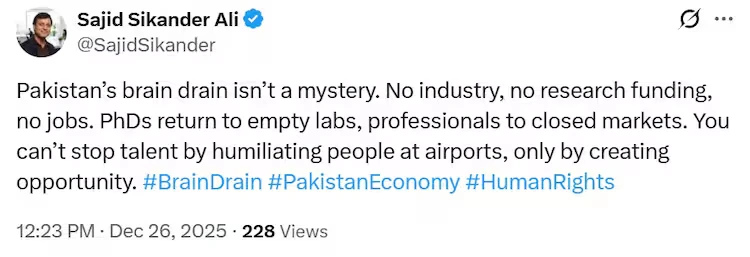
One widely shared post noted that PhDs return to empty laboratories, engineers to closed factories, and doctors to underfunded hospitals. Without opportunity, dignity and safety, retaining talent becomes impossible.
Others warned that Pakistan risks becoming a “hard state” where educated citizens feel unsafe expressing opinions, further accelerating the brain drain.

Long-Term Impact on Pakistan’s Future
The long-term consequences of the Pakistan brain drain are profound. A sustained loss of doctors threatens public healthcare, particularly in rural areas. The departure of engineers and accountants weakens infrastructure development, financial governance and industrial growth.
Remittances may offer short-term relief, but they cannot substitute for domestic innovation and skilled labour. Countries that fail to retain talent often struggle to move up the value chain, remaining dependent on external aid and imports.
Experts warn that reversing the trend will require more than slogans. Meaningful reforms in governance, economic policy, education and civil liberties are essential to restore confidence among professionals.

Conclusion: A Growing Gap Between Rhetoric and Reality
The widening gap between official rhetoric and lived reality has made the Pakistan brain drain impossible to ignore. While leaders speak of “brain gain”, the data tells a different story — one of frustration, flight and fading hope.
Unless Pakistan addresses the root causes driving its doctors, engineers and professionals away, the exodus is likely to continue. The challenge ahead is not just retaining talent, but rebuilding trust in a future worth staying for.
Related Reads
By The News Update Desk — Updated December 27, 2025