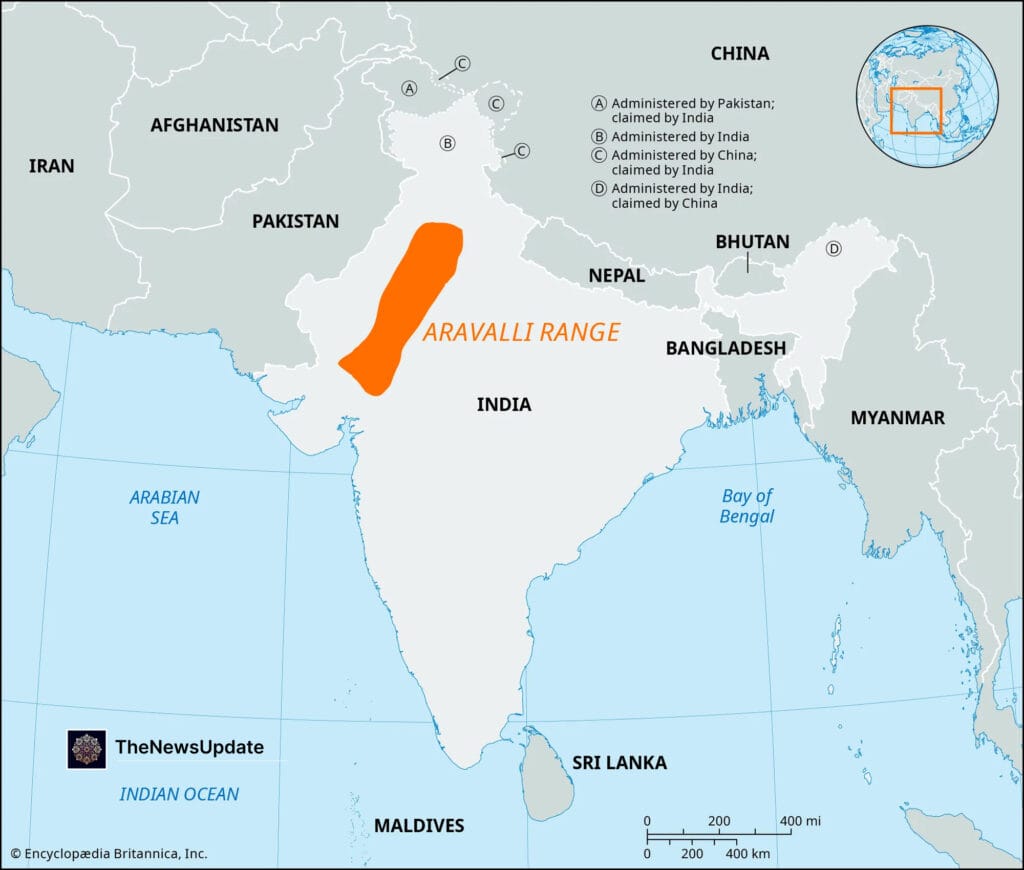
Protests have erupted across northern India after the Supreme Court accepted a new definition of the Aravalli hills, one of the world’s oldest geological formations stretching across Rajasthan, Haryana, Gujarat and parts of Delhi. The decision has sparked widespread concern among environmentalists, farmers, and local residents, who fear the move could weaken long-standing protections for an ecologically critical region.
Understanding the Aravalli Hills
The Aravalli hills are estimated to be over 1.5 billion years old, making them among the oldest mountain systems on Earth. Far from being just a geographical feature, the Aravallis play a crucial role in preventing the eastward expansion of the Thar Desert, recharging groundwater aquifers, and regulating temperatures across north-western India.
In the Delhi-NCR region, the hills act as a natural shield against dust storms and air pollution. Their forests and scrublands support wildlife corridors and sustain rural livelihoods, particularly for farming and pastoral communities.
यह भी पढ़े:
 Osman Hadi Killers Fled to India via Meghalaya Border: Dhaka Police Reveal Shocking Escape Route
What Changed in the Supreme Court Definition
The controversy centres on a new definition accepted by the Supreme Court following recommendations from the federal government. Under the revised framework, an Aravalli hill is defined as any landform rising at least 100 metres above the surrounding terrain. Two or more such hills within 500 metres of each other, along with the land between them, are categorised as an Aravalli range.
Environmental groups argue that this height-based definition oversimplifies a complex geological and ecological system. Many low-lying, scrub-covered hills that are part of the Aravalli system fall below the 100-metre threshold but still play a vital role in groundwater recharge and desertification control.
Why Aravalli Hills Protests Are Growing
Over the weekend, peaceful demonstrations took place in cities including Gurugram and Udaipur. Protesters included local residents, farmers, environmental activists, lawyers, and representatives from opposition political parties.
यह भी पढ़े:
 Bulldozer Raj Karnataka Demolitions: Congress Govt Faces Backlash After 400 Muslims Left Homeless
Neelam Ahluwalia, a founder member of the People for Aravallis group, warned that the new definition risks undermining the hills’ ecological function. She said that many of the lower hills, though less visible, are critical for preventing desertification and supporting livelihoods.
Environmental activist Vikrant Tongad stressed that internationally, mountain systems are identified by their function rather than arbitrary elevation limits. He argued that any landform geologically connected to the Aravalli system and contributing to ecological stability should be protected, regardless of height.
- Risk of increased mining and construction
- Damage to wildlife corridors
- Reduced groundwater recharge
- Worsening air quality and heat stress in cities
Political Reactions and Public Statements
The Aravalli hills protests have drawn strong political reactions. Samajwadi Party chief Akhilesh Yadav said that protecting the Aravallis is inseparable from Delhi’s survival, citing their role in controlling dust and pollution.

Rajasthan Congress leader Tika Ram Jully described the range as the state’s lifeline, warning that without it, large areas up to Delhi could have turned into desert. These statements have helped push the issue into the national spotlight.
Government’s Position and Clarifications
The federal government has sought to reassure critics, stating that the new definition is intended to strengthen regulation and bring uniformity across states. The environment ministry said it is incorrect to assume that mining would automatically be allowed on all landforms below 100 metres.
According to the government, areas within the Aravalli hills or ranges are excluded from new mining leases, while existing ones may continue only if they follow sustainable mining norms. Mining remains banned in protected forests, eco-sensitive zones, wetlands, and other inviolate areas.

Environment Minister Bhupender Yadav said that only around 2% of the total 147,000 square kilometre Aravalli range could potentially be mined, and only after detailed environmental studies and official approvals.
Environmental Risks and Long-Term Impact
Despite these assurances, environmental experts warn that redefining the Aravallis narrowly could have long-term consequences. They argue that even limited mining and construction in fragile zones could accelerate desertification, reduce water availability, and worsen climate impacts across north-western India.
For many protesters, the issue reflects a broader concern about development policies that prioritise short-term economic gains over long-term environmental security.
यह भी पढ़े:
 Canada Hospital Killed Indian-Origin Man: Wife Alleges Medical Negligence After 8-Hour Wait
What Happens Next
Several groups involved in the Aravalli hills protests have said demonstrations will continue. Some are exploring legal options to challenge the new definition, arguing that it does not adequately reflect scientific and ecological realities.
As climate pressures intensify across India, the future of the Aravalli hills is likely to remain a contested issue, raising fundamental questions about environmental governance, sustainable development, and the right to a healthy environment.
Related Reads
By The Morning News Informer— Updated December 22, 2025