Severe weather has hit the Storm Bram UK, named by Ireland’s Met Eireann, continues to batter the region with strong winds and heavy rain. The Met Office has issued multiple warnings, including two amber alerts, as the storm affects Scotland, Northern Ireland, and parts of England and Wales.
Amber Warnings and Expected Wind Speeds
The strongest winds are expected across north-west Scotland, with gusts reaching up to 90mph (144km/h). Amber warnings have been issued for north-west Scotland from 16:00 Tuesday to 03:00 GMT Wednesday, and for parts of Northern Ireland where gusts may hit 80mph (129km/h). Affected areas in Northern Ireland include Antrim, Fermanagh, Londonderry, and Tyrone, with warnings in effect from 14:00 to 19:00 GMT.
The amber warnings indicate that significant impacts are likely, including transport delays, cancellations, and potential damage to buildings. Residents are advised to secure outdoor objects and stay indoors where possible during the peak of the storm.
यह भी पढ़े:
 Royal Yacht Britannia Visit to Ireland: ‘Superiority’ Concerns Revealed in Newly Released Files
Yellow Warnings and Wider Coverage Storm Bram UK
Yellow warnings for wind have also been issued across other regions. West Wales and south-west England were under yellow alerts from 22:00 Monday to 16:00 GMT Tuesday, with gusts of 40-50mph (64-80km/h). Northern Ireland will continue to see yellow alerts from 09:00 to 22:00 GMT Tuesday, while much of Scotland and northern England will be under yellow warnings from 12:00 to 23:59 GMT.
Further yellow warnings cover much of Scotland on Wednesday. Gusts of 50-60mph (80-97km/h) are expected widely, while exposed coastal areas and higher ground could experience gusts above 70mph (113km/h). Authorities warn that travel disruption and property damage are possible in these regions.
Rainfall and Flooding Risks
Storm Bram is bringing heavy rainfall to already saturated regions. Over 100mm (3.94in) fell in Whitebarrow, Dartmoor, within 24 hours, while Treherbert in south Wales received 60mm (2.4in). The Met Office has highlighted the risk of flash flooding, fast-flowing rivers, and dangerous road conditions. Residents are urged to avoid unnecessary travel during the storm.

Although amber warnings for heavy rain across Dartmoor and the Brecon Beacons have expired, flood alerts remain in place across England and Wales. Coastal flooding caused by strong winds is also a concern. Authorities emphasize that fast-moving or deep floodwaters are dangerous and can pose a threat to life.
Impact on Transport and Infrastructure
The combination of strong winds and heavy rain is expected to disrupt transportation networks. Train services may be delayed or canceled, flights could face interruptions, and roads may become hazardous due to flooding and debris. Power outages are also possible as trees and branches are brought down by high winds.
The Met Office advises travelers to check the status of public transport before heading out and to consider postponing non-essential travel during periods of peak wind and rainfall.

Storm Bram’s Meteorological Background
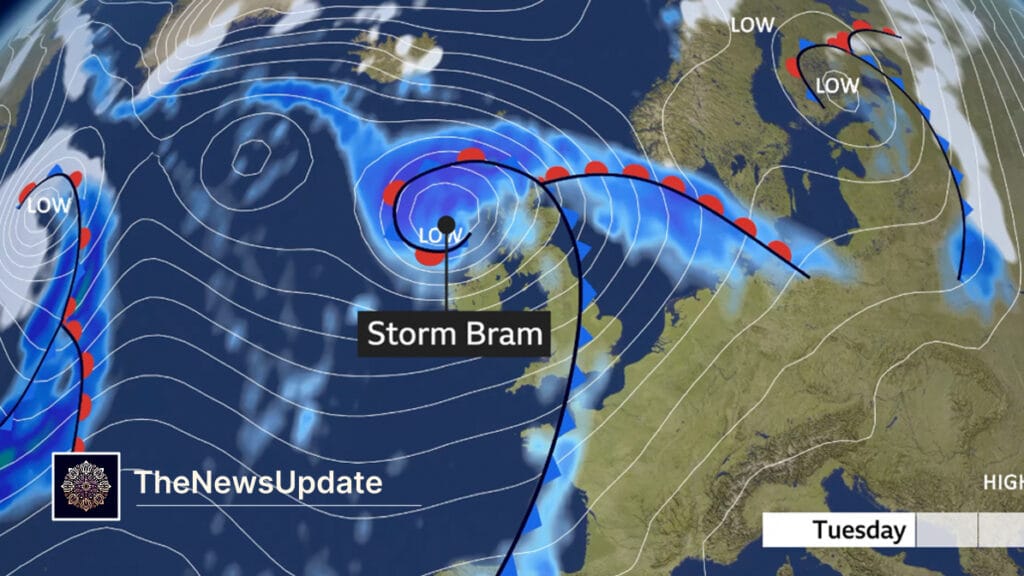
Storm Bram developed rapidly on Tuesday, moving northwards to the west of the UK. Meteorologists note that the storm is strengthening as it approaches the Irish Sea coasts and north-west Scotland. Meteorological charts show Bram positioned to the west of Scotland with active weather fronts and areas of rainfall extending across the UK.
The storm’s development follows previous named storms in the UK, including Storm Benjamin and Storm Claudia, named by France and Spain respectively. The UK Met Office and associated storm-naming group maintain a rotating list of storm names, with Bram following Storm Amy in the sequence. The next named storm is expected to be Chandra, should medium or high impacts occur.
Safety Measures and Recommendations
Residents in affected areas are advised to:

- Stay indoors during periods of strongest winds and heavy rain.
- Avoid traveling unless necessary and check road and rail updates.
- Secure loose outdoor items to prevent them from becoming hazards.
- Monitor local news and Met Office updates for evolving weather conditions.
- Be aware of flood-prone areas and avoid driving or walking through flooded roads.
Local Observations and Reports
Communities in north-west Scotland and Northern Ireland have reported strong gusts bringing down branches and minor structural damage. Flooding has been observed in low-lying areas, and local authorities are deploying emergency services to respond to incidents as they arise. In Devon and south Wales, rainfall has caused water levels in rivers to rise rapidly, prompting localized evacuation warnings in some areas.

Comparison with Previous Storms
Storm Bram continues the pattern of intense winter storms affecting the UK. Earlier this year, Storm Amy caused significant disruption across England, Scotland, and Wales. Compared to Amy, Bram is expected to bring higher wind speeds in Scotland and Northern Ireland, while rainfall totals in the south-west are comparable to previous severe events.
Conclusion
Storm Bram is a significant weather event impacting much of the UK with severe wind gusts and heavy rainfall. Amber warnings in north-west Scotland and parts of Northern Ireland highlight the potential for substantial disruption to travel, infrastructure, and daily life. Residents are urged to follow official guidance, avoid unnecessary travel, and remain aware of flood risks. The storm serves as a reminder of the importance of preparedness during the winter storm season in the UK.

Authorities continue to monitor the storm closely, issuing updates and alerts to keep the public informed as Bram moves across the region. With ongoing saturated ground and rising river levels, vigilance remains crucial for all affected communities.
For continued updates on UK news and digital finance developments, visit our Tech News section and The News Update.