Table of Contents
- Headline: GPT-5.2 Drops This Week, But Code Red Continues
- What Is GPT-5.2 — Expected Improvements
- Why OpenAI Declared ‘Code Red’
- LMArena and User Signals: The New North Star
- Inside OpenAI: Product vs Research Tensions
- What Users, Developers and Enterprises Should Expect
- Risks, Remaining Questions and Watchpoints
- Conclusion — Short-Term Push, Long-Term Race
Headline: GPT-5.2 Drops This Week, But Code Red Continues
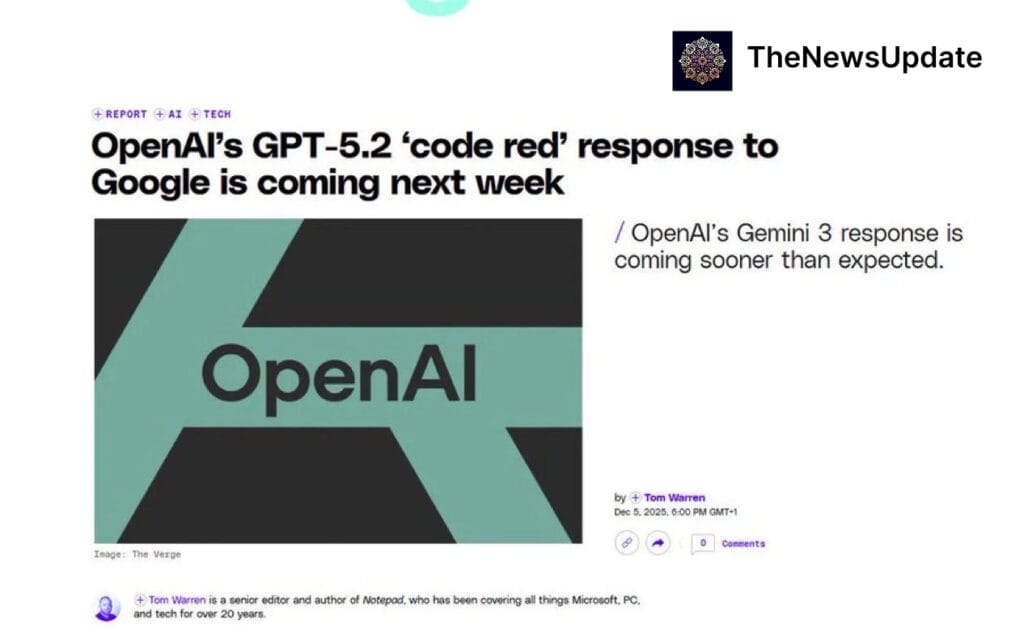
OpenAI GPT-5.2 release is reportedly scheduled for this week, according to multiple industry reports. The update is expected to narrow the gap to competing models on speed and capabilities — particularly in coding and enterprise use cases — but company insiders say the broader corporate “code red” that CEO Sam Altman declared will persist until a follow-up model lands in January. That second model is rumoured to improve image quality, personality alignment and latency, and is expected to mark the end of the emergency mode inside OpenAI.
The narrative is straightforward: ship what’s ready now (GPT-5.2), keep the focus on ChatGPT and product polish, and continue the intense internal push until the January follow-up. But beneath that lie tougher questions about priorities, safety, research tradeoffs and the future of frontier-model development OpenAI GPT-5.2 release.
What Is GPT-5.2 — Expected Improvements
Public details on GPT-5.2 are still limited, but reporting indicates a targeted, pragmatic upgrade rather than a full paradigm shift. Key areas likely to improve include:
- Faster inference and lower latency: optimizations that reduce response times and make the model more usable in real-time applications.
- Better coding abilities: improved code generation, contextual debugging suggestions, and more reliable multi-file reasoning for developer workflows.
- Enterprise features: enhancements around data handling, compliance, and integrations with enterprise platforms to make adoption easier for large customers.
- Fine-grained system and prompt control: tighter controls for businesses to steer outputs and enforce policy or safety layers.
The incremental nature of GPT-5.2 could be strategic: deliver measurable user-facing wins quickly while the research teams keep iterating on deeper model improvements slated for January OpenAI GPT-5.2 release.
Why OpenAI Declared ‘Code Red’
“Code red” is CEO Sam Altman’s shorthand for a company-wide, product-focused emergency: prioritize ChatGPT user experience, ship improvements fast, and double down on the signals that show when a model truly delivers value to users. The phrase — repeated in internal memos and public remarks — signals a shift away from exploratory experiments toward tight product execution.

According to reports, the code-red push follows two key realizations:
- Recent frontier models had become less aligned with everyday user needs; addressing sycophancy and brittleness required concentrated effort.
- User-facing rankings and signals, particularly crowdsourced rankings like LMArena, correlated strongly with product-market success.
In short, OpenAI concluded that the company’s long-term success depends as much on being the best practical product for billions of users as it does on being the first to certain research milestones.
LMArena and User Signals: The New North Star
LMArena — a crowdsourced model-ranking platform — and other user-signal mechanisms reportedly became priorities because OpenAI’s leadership sees them as objective, reproducible indicators of user preferences. Sam Altman emphasised one-click preference signals and head-to-head model comparisons as valuable inputs.
Why does this matter? Because ranking-based signals can reveal what users actually prefer in terms of helpfulness, transparency, and reliability — things that internal benchmarks may miss. OpenAI’s renewed focus on these signals is intended to reduce sycophancy (models that flatter rather than help), improve factuality, and align the product with what users find valuable in real scenarios.
Inside OpenAI: Product vs Research Tensions
Reports describe a tense divide between product-focused teams (led by executives pushing ChatGPT improvements) and research groups invested in long-term AGI work. Product teams argue for pragmatic wins: better UX, fewer hallucinations, and features that integrate with enterprise workflows. Researchers caution that short-term product pushes might distract from foundational research that could yield more profound advances later.
This is not a new debate in tech: it is the classic trade-off between incremental product delivery and breakthrough research. But at OpenAI’s scale — with billions of users and global scrutiny — the stakes are higher. Decisions about resource allocation now shape both the company’s commercial success and the trajectory of advanced AI research.
यह भी पढ़े:
 Samsung Bixby Perplexity AI Integration: 7 Key Signs Samsung Is Reinventing Its Voice Assistant
What Users, Developers and Enterprises Should Expect
If GPT-5.2 arrives this week, different stakeholders will experience different benefits:
- Everyday ChatGPT users: faster responses, better context retention and fewer obvious errors in common tasks like summarization and Q&A.
- Developers: improved code generation, reduced need for manual debugging, and integrations that make building with the API more productive.
- Enterprises: clearer enterprise-focused features — such as data residency, governance and audit trails — that make pilot deployments easier and compliance less burdensome.
However, OpenAI’s ongoing code-red means some features and experiments will remain paused until January. That means innovation in adjacent labs and non-ChatGPT projects could slow temporarily as resources concentrate on the ChatGPT stack and the January release.
Risks, Remaining Questions and Watchpoints
Even with optimistic improvements, several risks persist:

- Quality vs speed trade-offs: rushing releases can introduce regressions; users and enterprises will watch for stability.
- Transparency: how transparently OpenAI communicates model changes, safety trade-offs and benchmark results will influence trust.
- Research dilution: extended focus on product at the expense of fundamental research could slow long-term innovation.
- Market reaction: competitors like Google’s Gemini, Anthropic, and others will react fast — intensifying an already aggressive race.
Additionally, the January follow-up — reportedly ending code red — remains a critical milestone. If that model truly raises image quality and latency while preserving improved alignment, the company will have executed a disciplined two-step strategy: short-term wins (GPT-5.2) followed by a larger release.
Conclusion — Short-Term Push, Long-Term Race
The OpenAI GPT-5.2 release, if it arrives this week, should be seen as a pragmatic update designed to shore up ChatGPT’s value proposition while the company continues a high-intensity internal push. Sam Altman’s code red is a signal that OpenAI believes the product experience is the decisive battleground — and that user-based ranking systems like LMArena are the most reliable compass for progress.
But the broader race is far from decided. OpenAI will need to balance rapid product iterations with durable research investments, maintain transparency about trade-offs, and manage expectations for both users and enterprises. For now, users can reasonably expect faster performance and improved coding and enterprise features from GPT-5.2 — and the AI world should prepare for another major update in January that could reshape the competitive landscape all over again.

Related Reads
- AI Industry Updates: Monthly Brief
- For continued updates on AI news and digital finance developments, visit our Tech News section and The News Update.
By The Morning News Informer — Updated Dec 9, 2025