Table of Contents
- Sberbank’s Vision: How AI Became the Core of Its Strategy
- Sberbank CEO Herman Gref AI Development Amid Sanctions
- India’s Role in Sberbank’s Next AI Chapter
- Why Sovereign AI Matters: Gref’s Perspective
- Conclusion: What’s Next for Sberbank and India?
- Related Reads
Sberbank’s Vision: How AI Became the Core of Its Strategy
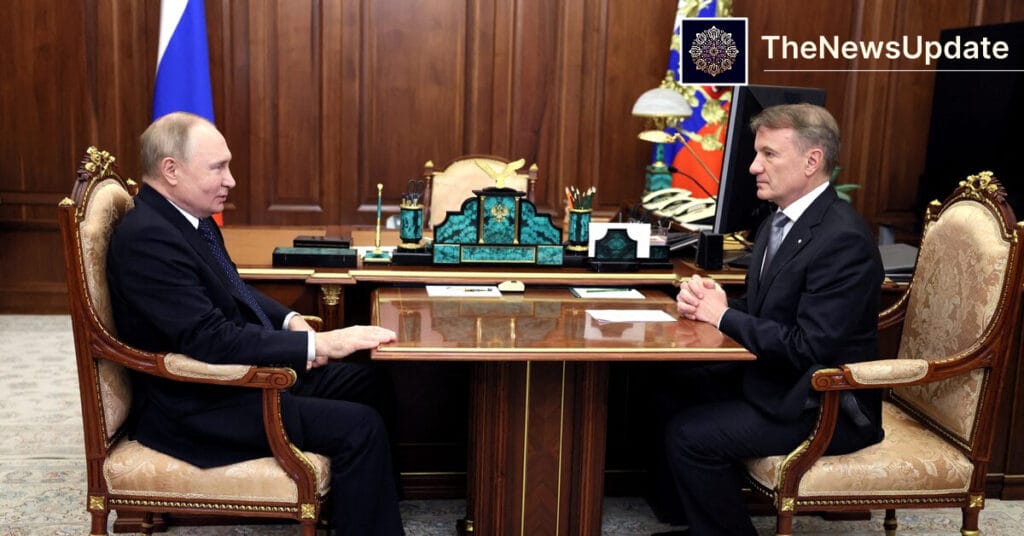
The journey of Sberbank CEO Herman Gref AI Development is a story of long-term planning, strategic resilience, and the determination to stay technologically independent at a time when many global institutions began to rely heavily on U.S. tech giants. Gref highlighted in his recent interaction with Gadgets360 that the bank has been investing in artificial intelligence for more than 15 years. This was not a sudden shift, but a slow and steady transformation of Sberbank from a traditional financial institution into a technology-driven enterprise with its own AI ecosystem.
What makes the story even more remarkable is that Sberbank’s AI evolution began before the world widely recognised the potential of AI in banking. While many financial institutions initially focused on chatbots or automation, Sberbank was building foundation models, machine learning systems for fraud detection, predictive algorithms for user behaviour, and even its own multimodal LLM named GigaChat.
Gref explained that the bank has developed deep R&D capabilities and employs more than 3,000 engineers, researchers, and data scientists. These are not outsourced teams or temporary contractors but full-time specialists working on long-term technological roadmaps. The company’s heavy investment in human capital allowed Sberbank to retain expertise in-house, which ultimately helped the organisation weather political and economic instability.
In addition to its internal development, Sberbank built strong technical partnerships, particularly with China. While the West began restricting technology access, Chinese tech ecosystems became essential collaborators. Gref openly acknowledged how China played a critical role in supporting Sberbank’s AI capacity-building—an unusual but telling insight into the shifting global technological alliances.
Today, Sberbank operates more like a hybrid between a financial institution and a major AI research centre. The models it created, including GigaChat and the Kandinsky image- and video-generation suite, are designed not only for Russian-language applications but also for broader enterprise use. Many of these tools are partially open-source, making Sberbank a surprising contributor to the global AI community.

Sberbank CEO Herman Gref AI Development Amid Sanctions
One of the most compelling aspects of Sberbank CEO Herman Gref AI Development is how the institution used sanctions—intended to restrict Russian technological capabilities—as a catalyst for innovation. According to Gref, the bank had to transition from relying on U.S. technologies to building alternatives entirely in-house.
Gref shared a powerful reflection: “If you asked me six years ago whether it is possible to live without American technology, my answer would be no. But now, it is a fact.” This comment not only shows how far Sberbank has come but also indicates a shift in global technological self-sufficiency. Sanctions forced the organisation to accelerate development, innovate faster, and become technologically independent.
This technological pivot included:
- Building proprietary foundation models from scratch
- Developing multi-language capabilities and multimodal LLMs
- Creating a sustainable research and cloud infrastructure
- Expanding global collaborations outside the West
- Establishing new teams to handle hardware and AI stack optimisation
Gref described this transformation as “difficult but excellent training,” emphasising how limitations often drive creative engineering. The team had to experiment, fail, iterate, and ultimately design high-efficiency models optimised for Russian language processing and use cases across finance, education, telecom, and services.
Today, Sberbank claims to have an AI infrastructure that can function without American technology—a bold and rare statement in the AI industry, where dependence on NVIDIA, Google, Microsoft, AWS, and Meta remains high for most global enterprises.
India’s Role in Sberbank’s Next AI Chapter
A major highlight of the Sberbank CEO Herman Gref AI Development discussion was the company’s strong interest in deepening its presence in India. Sberbank already has operational branches in the country and expects to secure a full banking licence within three years. But beyond banking, its next big focus is AI collaboration.
यह भी पढ़े:
 Samsung Bixby Perplexity AI Integration: 7 Key Signs Samsung Is Reinventing Its Voice Assistant
The bank currently runs an active IT hub in Bengaluru and is preparing to open another in Hyderabad—two cities central to India’s tech innovation. According to Gref, several Indian companies have already approached Sberbank to explore partnerships in AI development, foundation model training, and enterprise-level AI deployment.
The collaboration is expected to include:
- Joint development of AI models and tools
- Capacity-building programs for Indian engineers
- Integration of GigaChat and Kandinsky models into Indian enterprises
- Supporting Indian firms in creating sovereign AI systems
- Cross-border innovation for finance, telecom, and education
Gref highlighted that India’s engineering talent makes it an ideal partner. He noted that some Indian companies are already working on fundamental AI models and are interested in transferring knowledge to Russian partners.

This two-way knowledge transfer is significant. It reflects an evolving global tech landscape where AI expertise is not flowing in a single direction (from West to East) but becoming more distributed.
Why Sovereign AI Matters: Gref’s Perspective
Another important part of the Sberbank CEO Herman Gref AI Development narrative is the strong emphasis on sovereign AI. Gref believes that large countries must develop AI models that are fully under their control—not dependent on foreign corporations or geopolitical conditions.
He argues that AI is becoming critical infrastructure, akin to electricity or telecommunications. Depending on foreign AI systems could expose national institutions to technological risk, data vulnerability, or geopolitical leverage.
यह भी पढ़े:
 New York Times Reporter, Authors Sue Google, OpenAI, Meta Over AI-Based Copyright Infringement
For India, this aligns with ongoing discussions about:
- Building India-specific foundation models
- Strengthening public-sector AI capabilities
- Expanding digital sovereignty
- Developing multilingual AI ecosystems for 1.4 billion people
Gref emphasised that India has both the talent and the scale to achieve sovereign AI and that collaboration between Indian and Russian institutions could accelerate progress for both nations.
Conclusion: What’s Next for Sberbank and India?
The future of Sberbank CEO Herman Gref AI Development appears increasingly intertwined with India’s fast-growing AI ambitions. As Sberbank expands its IT hubs, develops AI tools, and strengthens cross-border partnerships, India stands to benefit from experience accumulated under challenging conditions—especially in developing AI resilient to technological restrictions.

With mutual interest from Indian companies and Sberbank’s readiness to share AI capabilities, the next few years could see significant breakthroughs in finance AI, enterprise digitalisation, and national-level AI ecosystems.
In many ways, this collaboration signals a new era of global AI alliances—where innovation is driven not just by Silicon Valley, but by emerging partnerships across Asia.
Related Reads
By The Morning News Informer — Updated 4 December 2025