The India Blind Women Cricket World Cup 2025 has become a landmark moment not only for disability sports but also for women’s cricket in India. The inaugural edition of the tournament has shone a long-overdue spotlight on a group of visually impaired women who have battled economic hardship, social stigma, and infrastructural challenges to rise to international success. Their journey, filled with resilience and quiet determination, is now inspiring millions across India and beyond.
The first-ever Blind Women’s T20 World Cup, organised under the World Blind Cricket Council (WBCC), features six nations: India, Pakistan, Nepal, Sri Lanka, Australia, and the USA. Beginning on 11 November in Delhi and later shifting to Bengaluru and Colombo, the tournament marks one of the most transformative moments in the history of women’s blind cricket India Blind Women Cricket World Cup 2025.
India’s Unbeaten Run in the Group Stage
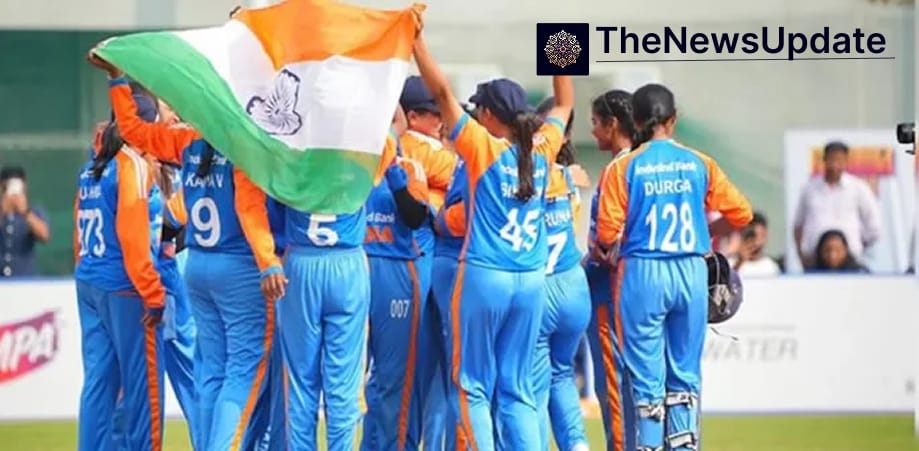
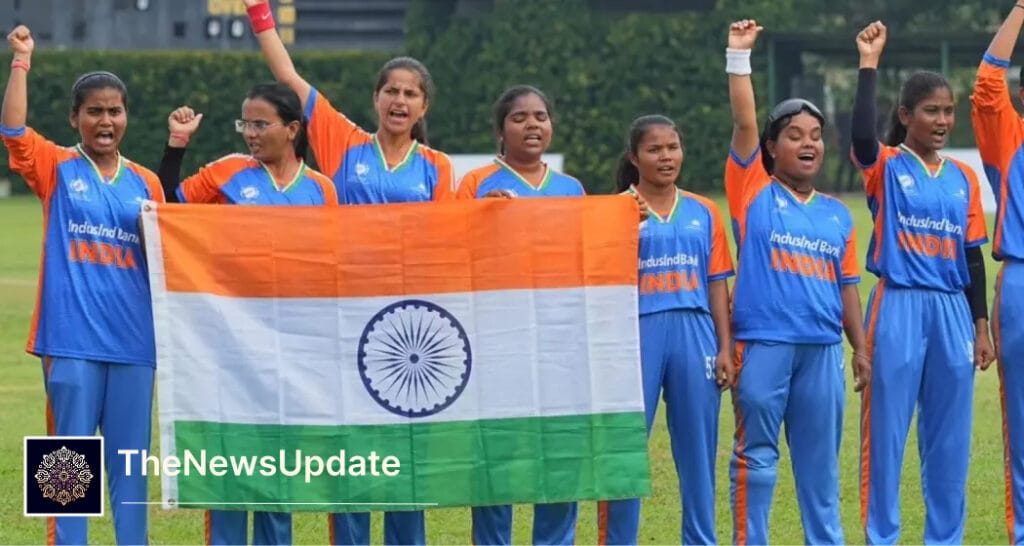
Team India has dominated the World Cup so far. Winning all five of their league matches, the squad became the first team to secure a place in the semi-finals. Their victory over Pakistan on 16 November in Colombo was especially emotional, symbolising both sporting excellence and the power of opportunity. The players’ celebrations on the field reflected a deep sense of pride for their country and their sport.
यह भी पढ़े:
 Osman Hadi Killers Fled to India via Meghalaya Border: Dhaka Police Reveal Shocking Escape Route
Blind cricket, unlike the mainstream version, uses a plastic ball fitted with metal bearings so that players can track its movement by sound. Teams include three categories of visual impairment — B1 (fully blind), B2, and B3. The ball is bowled underarm, gliding along the ground so that players can detect it easily. In the B1 category, every run scored counts as two, and batters use a runner for safety.
Despite the complexities of the sport, India’s players have shown sharp instincts, coordination, and unmatched teamwork — proving that blindness is no barrier to excellence when support and opportunities are available.
Who Are the Women Behind This Historic Campaign?
The 16-member Indian squad represents nine states across the country — Karnataka, Maharashtra, Odisha, Delhi, Assam, Rajasthan, Bihar, Madhya Pradesh, and Andhra Pradesh. What binds them together is not just cricket, but the extraordinary personal journeys that brought them here.
यह भी पढ़े:
 Bulldozer Raj Karnataka Demolitions: Congress Govt Faces Backlash After 400 Muslims Left Homeless
Deepika TC – Leading with Vision Beyond Sight
India’s captain, Deepika TC from Karnataka, lost her eyesight in infancy after an accident. Growing up in a farming family, she never imagined that cricket would shape her destiny. Deepika discovered the game in a special school where teachers encouraged her to participate despite her fears. Cricket helped her reclaim confidence and purpose.
Now leading India in the India Blind Women Cricket World Cup 2025, she describes this moment as the greatest of her life. She also expressed gratitude for the support received from Indian cricketers like Jemimah Rodrigues and Test captain Shubman Gill, whose encouragement has motivated the squad.
Ganga Kadam – A Fighter from Rural Maharashtra
Vice-captain Ganga Kadam comes from a family of nine siblings in Maharashtra. Her father, a farmer, enrolled her in a blind school to ensure she had access to education and a stable future. Cricket came into her life as a casual activity, but a mentor persuaded her to pursue it seriously.

Learning blind cricket requires mastering sound, timing, and mental mapping — and Ganga struggled initially. But her persistence paid off, and today she stands as one of India’s most dependable B2-category players, encouraging young visually impaired girls in her village to dream big.
Anekha Devi – The Rising Star from Jammu & Kashmir
Twenty-year-old Anekha Devi was born partially blind in Jammu and Kashmir. Her visually impaired uncle introduced her to blind cricket by urging her to attend a camp in Delhi. Overwhelmed at first, she quickly adapted to the audible ball system and impressed coaches with her instinctive batting.
In just two years, she climbed the ranks to the national team. She dreams of becoming a role model for visually impaired children in her state — something she never had growing up.
Phula Saren – A Tribal Girl Who Found Her Game
Phula Saren, 18, from a tribal community in Odisha, lost vision in her left eye at age five and lost her mother shortly after. Cricket entered her life through a teacher in a school for the blind. While her family hesitated to allow her to travel for tournaments, Phula insisted on following her passion. Her determination has transformed her into one of India’s most promising all-rounders.
Sunita Sarathe – Proving It’s Never Too Late
Sunita Sarathe from Madhya Pradesh didn’t begin cricket through school like many of her teammates. She graduated college, held jobs, and later joined a blind cricket camp on a friend’s suggestion. Initially overwhelmed, she trained relentlessly to make up for starting late. Today, she is known as one of India’s sharpest fielders.
The Rise of Blind Women’s Cricket in India
Blind men’s cricket has a long history, with the first 50-over World Cup held in 1998 and the inaugural T20 edition in 2012. Women, however, entered organised blind cricket internationally only in 2023.
यह भी पढ़े:
 Canada Hospital Killed Indian-Origin Man: Wife Alleges Medical Negligence After 8-Hour Wait
India’s women’s setup is governed by the Cricket Association for the Blind in India (CABI), established in 2011. Systematic scouting for women began in 2019 and resulted in the team’s first international match in 2023. Their gold medal at the IBSA World Games in Birmingham marked the beginning of a dream — one that is unfolding at the India Blind Women Cricket World Cup 2025.
CABI chairperson Mahantesh GK describes the journey as challenging but necessary: “We believed we were doing injustice by not giving visually impaired women the same opportunities as men. Money was a challenge. Getting teams was a challenge. But we persisted.”
Visibility, Broadcasts and Growing Recognition
The World Cup matches are streamed on the CABI YouTube channel and Prasar Bharati platforms. India’s matches are broadcast by national broadcaster Doordarshan — a breakthrough for disability sports visibility in India.
Coach Shika Shetty believes this exposure will transform public perception: “Now that people have watched these matches live and seen these women perform, families will be more supportive. It won’t feel like an unknown or unsafe path anymore.”
What This World Cup Means for India
The team’s performance has symbolic and structural significance:
- Representation: Women from rural and marginalised backgrounds are shining on a global stage.
- Inclusion: It highlights India’s growing support for disability sports.
- Women’s Empowerment: The players’ stories challenge stereotypes about gender, disability, and sport.
- Global Leadership: India is setting the standard for blind women’s cricket development.
The final of the World Cup will be held in Colombo on Sunday, where India hopes to claim a historic title and create a “double victory” following the sighted women’s T20 World Cup win earlier this month.
For India’s blind women cricketers, simply reaching this platform is already a victory. But with momentum, talent, and spirit on their side, they are chasing history — and inspiring an entire nation along the way.